Marine Stewardship Council
If a fishery can drown dolphins and still earn a sustainability label, the standard seems to protect profits first.
The Claim
They Say…
This seafood comes from a fishery that has been independently certified to the MSC’s environmental standard for fishing.
We Say…
If fisheries that have, in documented cases, entangled whales, drowned dolphins and trapped sea turtles, can still carry a sustainability badge… then “sustainable seafood” has quietly come to mean nothing at all.
The Reality
The Marine Stewardship Council (MSC) is the world’s largest seafood certification scheme. Its blue tick appears on thousands of seafood products and now covers around 14% of global fish landings.1 It was set up to try and prevent overfishing so that aquatic populations are not wiped out. But there are many problems with this scheme.
The MSC does not regulate fisheries itself. Instead, fisheries pay independent auditing companies to assess them against MSC standards. If they pass, they can market their catch using the MSC label and retailers can advertise the product as “sustainable seafood.” We would argue this system creates a blatant conflict of interest, since fisheries pay up to hundreds of thousands of dollars for certification, and retailers pay to use the label.2
The standards are designed to ensure fish stocks remain viable and fisheries are managed responsibly. But they do not eliminate many of the most disturbing impacts of industrial fishing. Certified fisheries still use equipment that results in “bycatch” which is the inevitable capture of non-target animals such as dolphins, sharks, turtles, and seabirds.3
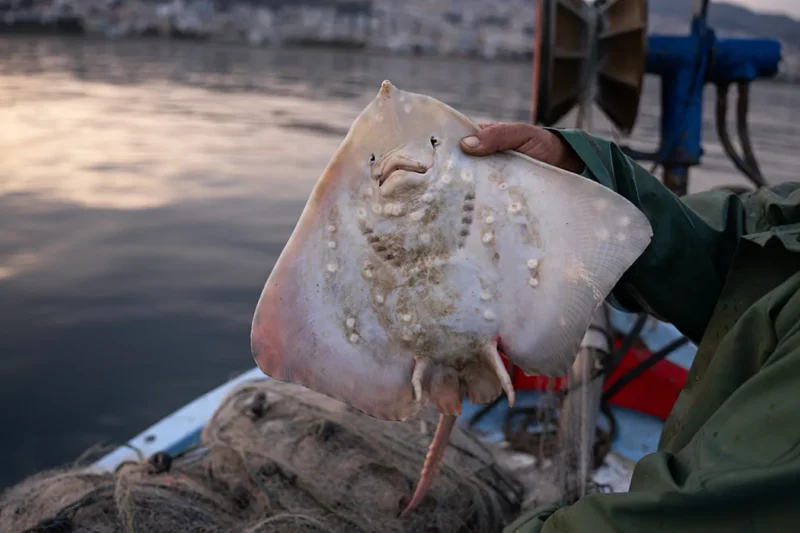
Investigations have documented incidents where MSC-certified vessels set nets around school of tuna that are feeding alongside whales and dolphins, trapping the animals inside. In some cases dolphins were caught and died in the nets.4
Other certified fisheries have been found entangling endangered species such as North Atlantic right whales in fishing gear with fatal consequences.5 There are fewer than 400 right whales left.
The MSC scheme has also faced controversy over certifying large-scale industrial fisheries, including Antarctic krill operations, that remove a key food source for whales, seals, and penguins. Conservation groups argue that the certification ignores worsening ecosystem pressures and climate impacts.6
The MSC label does not mean fishing has become harmless or humane. It means the fishery has met a set of management criteria that allow the industry to keep operating and profiting.
Consumers see a reassuring blue tick. Retailers get a powerful sustainability claim for their packaging. And the global machinery of industrial fishing carries on.
What They Don't Show You
Still permitted under this label:
Who Uses This








The Bottom Line
The MSC is yet another conflict-of-interest-ridden accreditation scheme that does not dismantle broken systems, just legitimises them.
Investigation and Reports
References
- 1. https://www.savingseafood.org/news/conservation-environment/blue-ticked-off-the-controversy-over-the-msc-fish-ecolabel/
- 2. https://www.theguardian.com/environment/2021/jul/26/blue-ticked-off-the-controversy-over-the-msc-fish-ecolabel
- 3. https://www.theguardian.com/environment/2021/jul/26/blue-ticked-off-the-controversy-over-the-msc-fish-ecolabel
- 4. https://worldcetaceanalliance.org/2023/04/19/whale-dolphin-abuse-ignored-by-msc/?utm_source=chatgpt.com
- 5. https://www.savingseafood.org/news/conservation-environment/blue-ticked-off-the-controversy-over-the-msc-fish-ecolabel/
- 6. https://www.theguardian.com/environment/2026/mar/04/worlds-largest-krill-harvester-row-blue-tick-sustainability-label
Take Action
-
 Frankenchickens
Ban Frankenchickens in the UK
Tell the Secretary of State at Defra to ban factory-farmed and fast-growing chickens known as Frankenchickens.
-
 Frankenchickens
Ask Your MP to Take Action
Ask why Frankenchickens are legal, when it’s unlawful to farm animals that will suffer because of how they have been bred.
-
 Factory Farming
End Factory Farming by 2040
It's time to bring it all down. Tell the government to block new factory farms and ban factory farming by 2040.
-
 Gas Chambers
Ban CO2 Gas Chambers for Pigs
Tell the Secretary of State at Defra to ban the use of CO2 gas chambers for pigs.
-
 Gas Chambers
Ask Your MP to Take Action
Ask why CO2 gas chambers are legal when the government’s Animal Welfare Committee recommends phasing them out?
-
 Gas Chambers
Tell Tesco to Drop CO2 Gas Chambers
Tell Tesco to stop selling meat from pigs killed in CO2 gas chambers, and commit to honest, transparent labelling.
-
 Gas Chambers
Tell McDonald’s to Drop Gas Chambers
Tell McDonalds to stop sourcing pork from pigs killed in CO2 gas chambers, and be transparent about slaughter methods.
-
 Donate
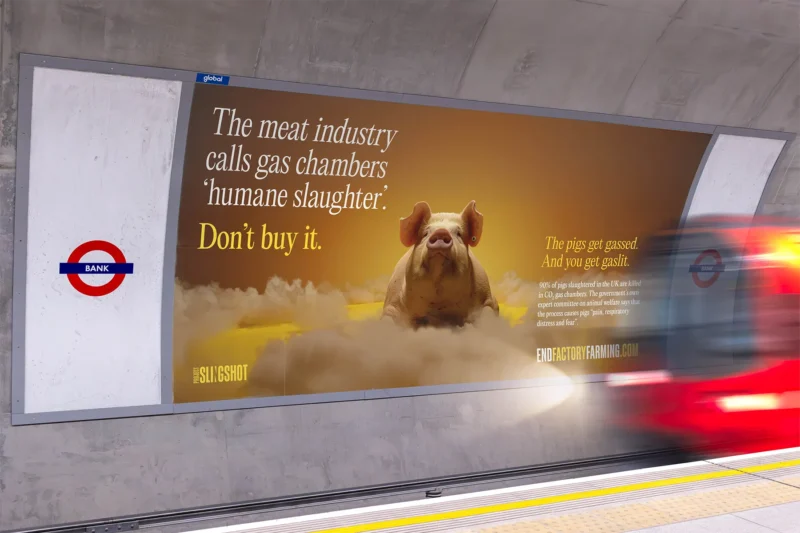
Power the Slingshot
Your monthly gift funds high-impact billboards, PR stunts, and campaigns that expose Big Ag and help us to bring down factory farming.