Barn Eggs
A dusty crowded warehouse-style shed is not freedom. Just another industry rebrand.
The Claim
They Say…
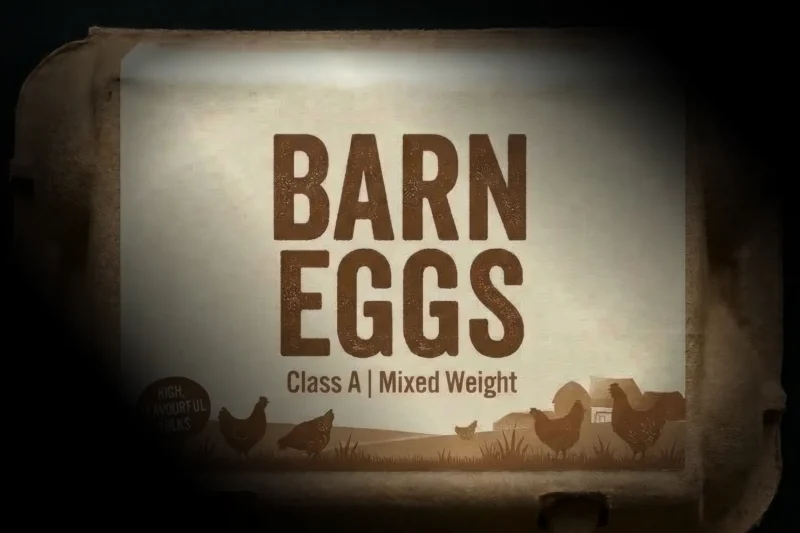
Barn eggs come from hens that are able to move freely around the house, with perches, litter to dustbathe in, nest boxes and plenty of space.
They Say…
Barn eggs come from hens that roam freely inside spacious barns with perches and nesting boxes.
We Say…
“Free to move around” and “plenty of space” sound generous until you realise thousands of hens are packed into a single shed with barely more room than a sheet of paper each. The industry, like those sheds, is full of sh*t.
The Reality
Barn eggs are laid by hens who are confined indoors and never go outside. The standards are set by the government department Defra, with input from the very industry that profits from low standards. It is a direct marketing response to consumers boycotting eggs from caged hens, but in reality it is a very small step forward for hen welfare and just dresses up the same industrial system.
In the UK, the law allows a maximum floor stocking density of 16.5 birds per m2, two pieces of enrichment per 1,000 birds, and a maximum colony size of 6,000 birds. In reality, this means each bird gets about the floor space of an A4 sheet of paper. That’s it. And two “enrichments” per 1000 birds, could mean two plastic bottles tied to a piece of string. No joke.
No room to stretch their wings properly.
No space to get away from other birds.
No space to rest without being stepped on or pecked.
So when you see “barn eggs” or read “airy barn” or “free to move around,” picture 16 or 17 birds crammed into the space of a small dining table for their whole lives. That’s what the law allows.
The term “barn eggs” is also used to describe free-range eggs, when there is a bird flu housing order and the birds are all kept indoors. But even free-range farms are not up to scratch.2
What They Don't Show You
Still permitted under this welfare term:
Who Uses This



The Bottom Line
Barn Eggs come from highly intensive, high throughput systems, where hens never see the sky. They are designed only for profit and it’s time they were banned.
Investigation and Reports
References
- 1. https://www.egginfo.co.uk/egg-facts-and-figures/production/barn-egg
- 2. https://www.animaljusticeproject.com/campaigns/cage-free-exposed
- 3. https://www.egginfo.co.uk/news/new-higher-welfare-standard-british-lion-barn-eggs?utm_source=chatgpt.com
- 4. https://www.the-independent.com/news/uk/home-news/free-range-eggs-tesco-mands-rspca-b2538181.html
Take Action
-
 Frankenchickens
Ban Frankenchickens in the UK
Tell the Secretary of State at Defra to ban factory-farmed and fast-growing chickens known as Frankenchickens.
-
 Frankenchickens
Ask Your MP to Take Action
Ask why Frankenchickens are legal, when it’s unlawful to farm animals that will suffer because of how they have been bred.
-
 Factory Farming
End Factory Farming by 2040
It's time to bring it all down. Tell the government to block new factory farms and ban factory farming by 2040.
-
 Gas Chambers
Ban CO2 Gas Chambers for Pigs
Tell the Secretary of State at Defra to ban the use of CO2 gas chambers for pigs.
-
 Gas Chambers
Ask Your MP to Take Action
Ask why CO2 gas chambers are legal when the government’s Animal Welfare Committee recommends phasing them out?
-
 Gas Chambers
Tell Tesco to Drop CO2 Gas Chambers
Tell Tesco to stop selling meat from pigs killed in CO2 gas chambers, and commit to honest, transparent labelling.
-
 Gas Chambers
Tell McDonald’s to Drop Gas Chambers
Tell McDonalds to stop sourcing pork from pigs killed in CO2 gas chambers, and be transparent about slaughter methods.
-
 Donate
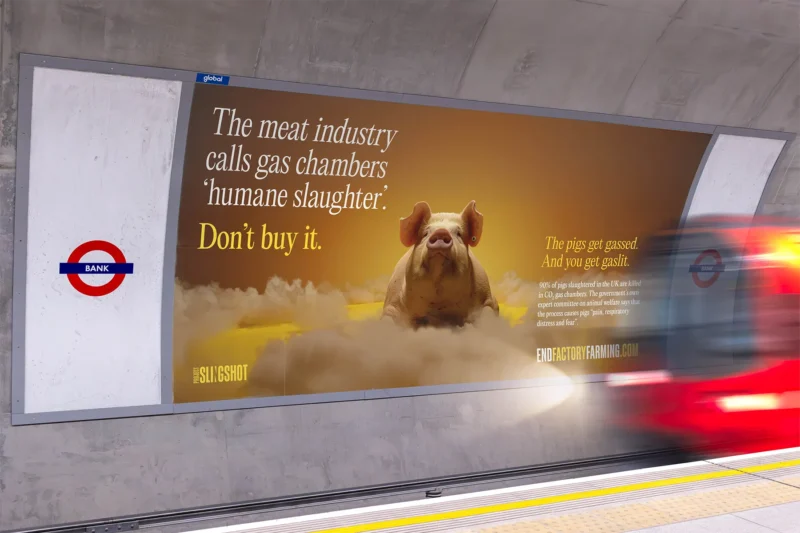
Power the Slingshot
Your monthly gift funds high-impact billboards, PR stunts, and campaigns that expose Big Ag and help us to bring down factory farming.