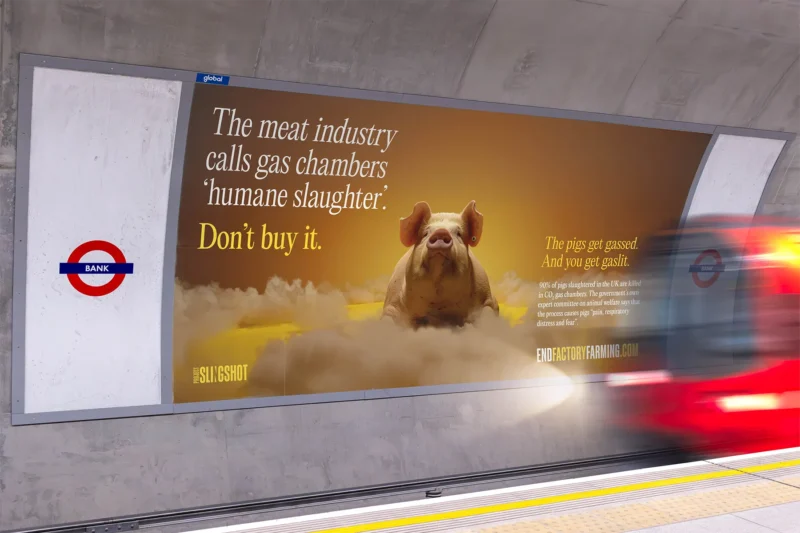
Are British pigs killed in gas chambers?
What the industry really means when it talks about humane slaughter.
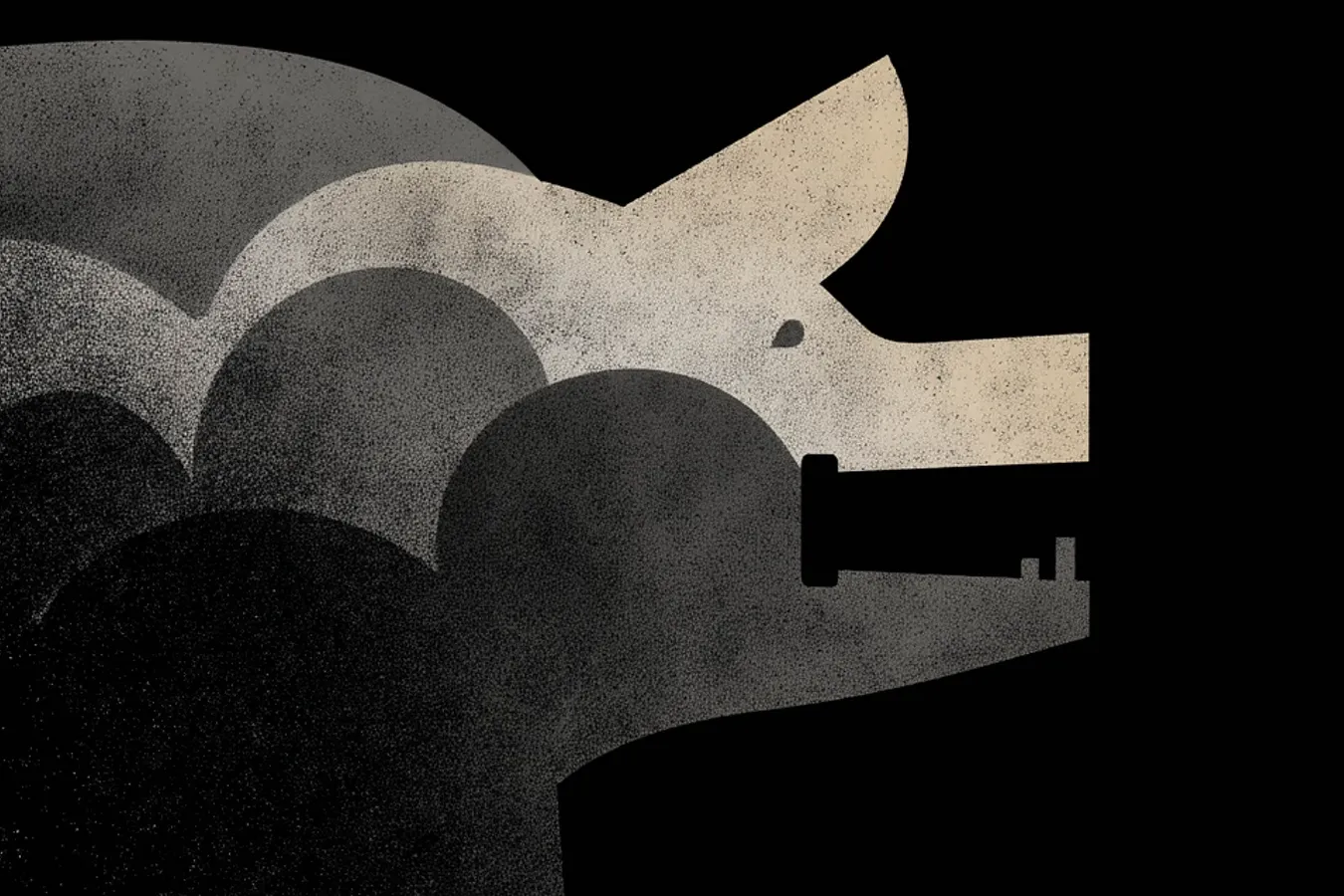
Currently around 90% of pigs in the UK are slaughtered in gas chambers filled with carbon dioxide (CO2). This is a shockingly inhumane method of slaughter which causes pain, respiratory distress and fear.
The industry wants us to believe that it is the “most humane” method that is commercially available but that is categorically not true. It’s just that it values low-cost methods over sparing the animals a terrifying end.
The pigs get gassed. And we get gaslit.

How did slaughtering animals in gas chambers begin?
Historically, animals were slaughtered by having their throats cut while they were fully conscious but in 1933, The Slaughter of Animals Act introduced a legal requirement for animals to be stunned prior to slaughter (with an exemption for specific religious communities). Typically, for pigs and poultry, this meant electrical stunning to bring about unconsciousness.
With electrical stunning, pigs have tongs applied to either side of their heads and a current passes through their brains that is intended to render the animals unconscious and insensible. After that, they are shackled by their back legs and their throats are cut. It’s not a good system. It causes fear and often pain, and in practice, does not always work.
But it is worse for poultry – chickens, turkeys, geese and ducks. They are shackled upside down first, while fully conscious, and then dragged through electrified water before having their throats cut. Given that the birds are often lame, many suffering with broken legs, shackling them by their legs is particularly horrific. This method of stunning and slaughter has always been known to cause birds severe distress and pain and, again, often the stun is not successful. For a long time, the industry was pressed to find a less inhumane way, and it was also searching for a cheaper one.
In the 1950s, a method of stunning was developed in the US and Denmark which used a mixture of CO2 in air to render pigs unconscious. This became a legally permitted method of stunning pigs in the UK in 1958 and started to be taken up. By the end of the 20th century, it was becoming increasingly common not just to stun pigs and poultry in CO2 gas chambers, but to kill them in it, too. Today, most pigs and poultry in the UK are killed this way.
How common is CO2 slaughter for birds?
Approximately 77% of broiler chickens and 99% of turkeys in the UK are killed with CO2 gas.This method is less inhumane than the previous method. It allows the birds to remain in their transportation crates, which means there is less handling, which is highly stressful, and no shackling. Plus, the birds are gassed to death in phases, and exposure to the aversive gas happens only once the birds have already lost consciousness. At least, this is the theory, but a UK investigation showed that gassing birds to death is far from being a humane method. Still, on balance, it may be less bad than electrical stunning. But that is not true for pigs.

Do pigs suffer in CO2 gas chambers?
They do, and it is a truly terrible way to die. This was acknowledged as far back as 2003 when the government’s own advisory committee recommended that the use of CO2 for pigs should be banned within five years because it was known to cause severe pain and distress. Since then, however, this slaughter method has only become more prevalent with supermarket Morrisons implementing gas slaughter for pigs as recently as 2017.
Currently around 90% of pigs in the UK are slaughtered in CO2 gas chambers. Groups of 5 to 7 pigs are confined in a cage, which the industry charmingly calls a “gondola”, as if the pigs were having a lovely time on the Venetian canals. Instead, they are lowered into a pit of high-concentration CO2 which causes them pain, respiratory distress and fear.
Pain: Inhalation of high concentration CO2 is painful because the gas dissolves in the mucous membranes of the eyes, nose, mouth and lungs to form carbonic acid.
Respiratory Distress: Inhalation of CO2 causes a prolonged inspiration, bigger breaths and decreased breathing frequency – in other words, hyperventilation or gasping.
Fear: High concentration CO2 stunning in pigs is associated with fear and anxiety due to exposure to novel stimuli, respiratory distress and experiencing a highly aversive yet inescapable environment.
Is it worse than the electrical stunning that went before? Well, it’s the age-old question: Would you rather have a punch in the face or a kick in the nuts? Neither are good, but it’s hard to say which is worse.
Alternatives to CO2 gas slaughter for pigs
Research has been ongoing to try and find a form of slaughter that is a) more humane and b) the industry will accept. Some methods fit the first criteria but the industry refuses to adopt them because it would mean a dip in its vast profits. (The largest UK pig farming corporation, Cranswick, has a turnover of £2.7 billion.)
Currently, the most promising suggestion is to keep the gas chambers but instead of using CO2, they could use inert gases such as helium or argon, which are not aversive to pigs. But still the industry is resisting because both gases cost more than CO2 with argon costing 4-5 times more, and both require the pigs to remain in the gas longer, which slows down the slaughter process.
What is the best way to slaughter pigs?
All lethal gas mixtures are associated with “some degree of welfare compromise” and, although an improvement, using inert gases would not be guaranteed to be pain-free or fear-free. There simply are no guaranteed humane ways to slaughter animals for consumption on a commercial scale, and so our recommendation would be to consider boycotting meat altogether.