Free-Range Eggs
Consumers asked for free-range. The industry slapped doors on their factory farms and carried on. Very little changed.
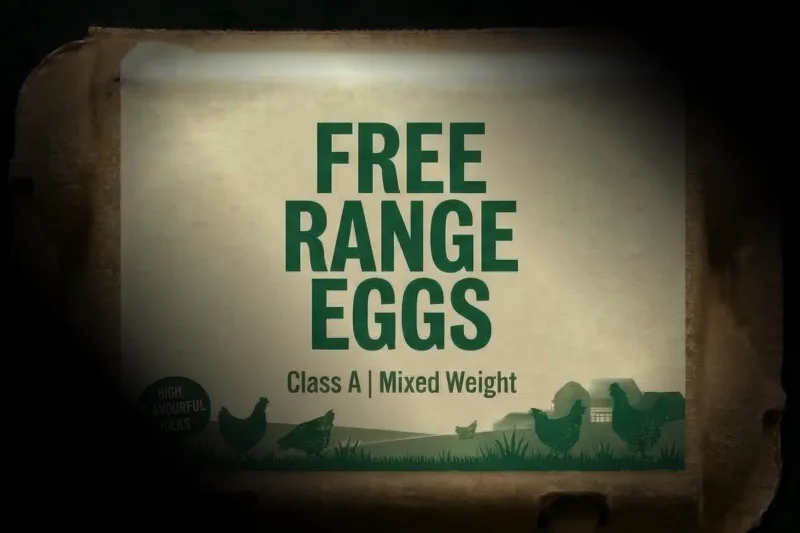
The Claim
They Say…
Our freshly laid eggs come from selected farms where hens are free to roam and forage on open pastures from dawn to dusk, and are safely housed in barns overnight.
They Say…
Our dedicated farmers create a calming & enriching environment with lots of natural shade, plenty of room to roam, and play kits.
They Say…
From hens who are free to roam in the fields of our British farms.
We Say…
The term "free-range" promises something that reality does not deliver. Investigations inside free-range egg farms have shown horrendous indoor conditions, pathetic attempts at enrichment, and access to the outdoors being restricted for days at a time. Even those who help make the rules, can’t follow them.
The Reality
The reality of “free-range” is not the outdoor paradise for chickens that is sold to us. It is a marketing term designed to reassure consumers that animals are having a lovely time, while leaving factory farming largely untouched.
UK law states that in order to market eggs as free-range, you must provide the following:4
- Hens must have continuous daytime access to runs which are mainly covered with vegetation and a maximum stocking density of 2,500 birds per hectare.
- The hen house conditions must comply with the regulations for birds kept in barn systems.
- Hens must be provided with enrichment such as nest boxes. Adequate perches, providing 15 centimetres of perch per hen, must also be provided. Litter must be provided, accounting for one-third of the ground surface – this is used for scratching and dust bathing.
However, countless investigations have shown free-range farms where these requirements are simply not met.
Regardless of the label they will later carry, all free-range chickens begin life in industrial hatcheries.5 After hatching, male and female chicks are separated and the males are gassed to death because they are useless to the egg industry.6 Being labelled free-range does not change this. Nor does it change the fact that free-range egg-laying hens typically do not see the sky until around 18 weeks into their average 100-week lifespan.
“Continuous access to the outdoors” sounds reassuring. In practice, it often means very little. Free-range chickens may spend most of their lives indoors, in crowded sheds, with the same indoor space allowance as barn-reared hens. Overcrowding leads to stress and injury, so free-range hens may be painfully debeaked. Even when the doors to the outside are open, they are often blocked by dominant birds, or avoided altogether because the outdoor area is barren and exposed and chickens need overhead cover to feel safe. Most free-range farms do not provide it.
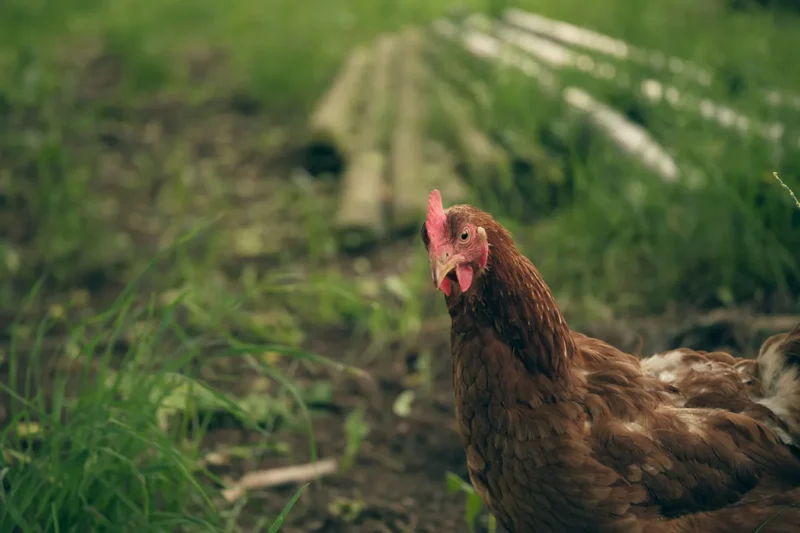
These standards are a long way from what people imagine when they buy free range, largely because egg marketing photography suggests the birds are all living it up in a sunlit meadow. Step forward, the British Free-Range Egg Producers Association (BFREPA).
Free-range egg standards are set by the government department Defra, with input from industry bodies like BFREPA. In other words, the people who profit directly from weak free-range rules help to shape them. Even so, and in no surprise to anyone, the industry rarely abides by them. In 2024, investigations into farms owned by multiple BFREPA directors uncovered overcrowding, injury, disease, dead birds left on shed floors for days, and outdoor access doors kept shut for four consecutive days, in clear breach of UK law.7
Were all these producers removed from their positions, or stripped of their free-range or RSPCA Assured status? No. Many remain in post, operating as usual. When you help write the rules, it seems you are not expected to follow them. And their farms continue to supply “free-range” eggs to Co-op, Asda, Aldi, Costco, Tesco, M&S, and Sainsbury’s.8
Even companies like M&S or The Happy Egg Company, who claim to have far higher welfare standards than the legal minimum, have been linked to serious animal welfare failures through undercover investigations.9
Free-range fails, not because the rules are misunderstood, but because they are weak, industry-shaped, and barely enforced. There is no truly independent body holding farms to account. The label exists to comfort consumers, not to protect animals.
What They Don't Show You
Still permitted under this welfare term:
Who Uses This









The Bottom Line
Free range doesn't end factory farming. It helps hide it.
References
- 1. https://www.tesco.com/groceries/en-GB/products/252781973
- 2. https://thehappyegg.co.uk/
- 3. https://www.aldi.co.uk/product/merevale-british-large-free-range-eggs-6-pack-000000000000416688
- 4. https://www.egginfo.co.uk/egg-facts-and-figures/production/free-range-egg
- 5. https://www.lovefreerangeeggs.co.uk/hatching-rearing-chicks
- 6. https://www.animalaid.org.uk/news/the-egg-industry-is-cruel-heres-why/
- 7. https://www.animaljusticeproject.com/campaigns/cage-free-exposed
- 8. https://www.animaljusticeproject.com/campaigns/cage-free-exposed-part-two
- 9. https://www.independent.co.uk/news/uk/home-news/free-range-eggs-tesco-mands-rspca-b2538181.html
Take Action
-
 Frankenchickens
Ban Frankenchickens in the UK
Tell the Secretary of State at Defra to ban factory-farmed and fast-growing chickens known as Frankenchickens.
-
 Frankenchickens
Ask Your MP to Take Action
Ask why Frankenchickens are legal, when it’s unlawful to farm animals that will suffer because of how they have been bred.
-
 Factory Farming
End Factory Farming by 2040
It's time to bring it all down. Tell the government to block new factory farms and ban factory farming by 2040.
-
 Gas Chambers
Ban CO2 Gas Chambers for Pigs
Tell the Secretary of State at Defra to ban the use of CO2 gas chambers for pigs.
-
 Gas Chambers
Ask Your MP to Take Action
Ask why CO2 gas chambers are legal when the government’s Animal Welfare Committee recommends phasing them out?
-
 Gas Chambers
Tell Tesco to Drop CO2 Gas Chambers
Tell Tesco to stop selling meat from pigs killed in CO2 gas chambers, and commit to honest, transparent labelling.
-
 Gas Chambers
Tell McDonald’s to Drop Gas Chambers
Tell McDonalds to stop sourcing pork from pigs killed in CO2 gas chambers, and be transparent about slaughter methods.
-
 Donate
Power the Slingshot
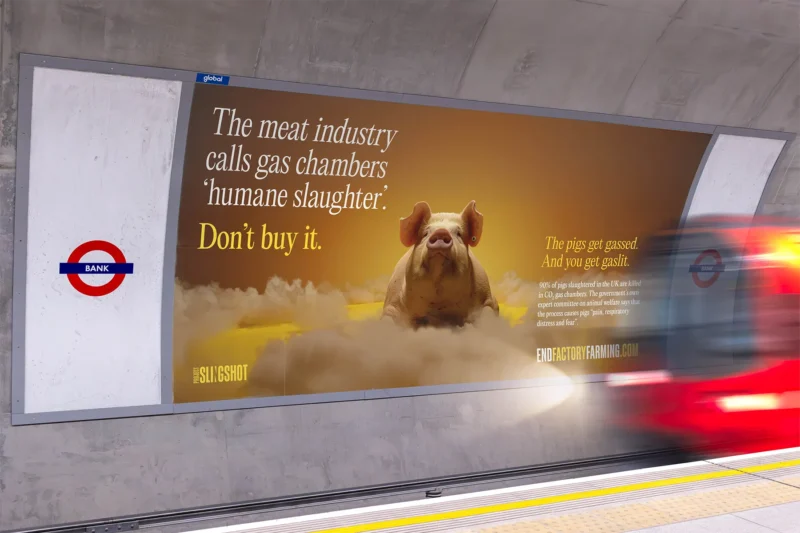
Your monthly gift funds high-impact billboards, PR stunts, and campaigns that expose Big Ag and help us to bring down factory farming.