Slower Grown
“Slower grown” sounds nice but the birds still grow too fast, confined inside intensive systems.
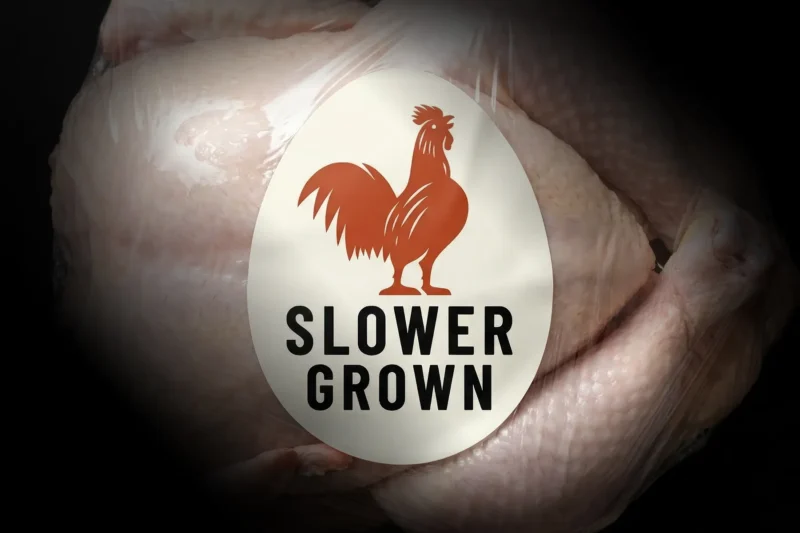
The Claim
They Say…
Our Slower Grown fresh chicken range is 100% British and reared to enhanced welfare standards, verified by RSPCA Assured. These selected breeds are reared for a longer period to ensure succulence and taste.
They Say…
All our chicken is from slower reared breeds, raised with more space, by farmers who share our higher welfare values.
We Say…
When chickens engineered to grow at unnatural speeds are allowed to live a few days longer, supermarkets cash in and call it “higher welfare.” For chickens who are confined in industrial farms, mutilated, and then gassed to death, it changes very little.
The Reality
“Slower grown” or “slower reared” is a meaningful welfare improvement, but it is not like the chickens had time to enjoy their lives, smell the roses, and take a nap in sunlit clover. There are still a wealth of deeply problematic issues because slower-grown birds are still factory farmed.
Slower-grown birds are a different breed to the fast-growing Frankenchickens who are prone to leg and joint pain, lameness, organ failure, and collapsing under their own weight. So, in that respect, slower grown is a significant improvement. But the birds are still grown to adult size unnaturally fast. Investigations into RSPCA Assured farms, housing “slower grown” breeds of broiler chicken, found many of the same welfare issues faced by fast-growing “Frankenchickens”1
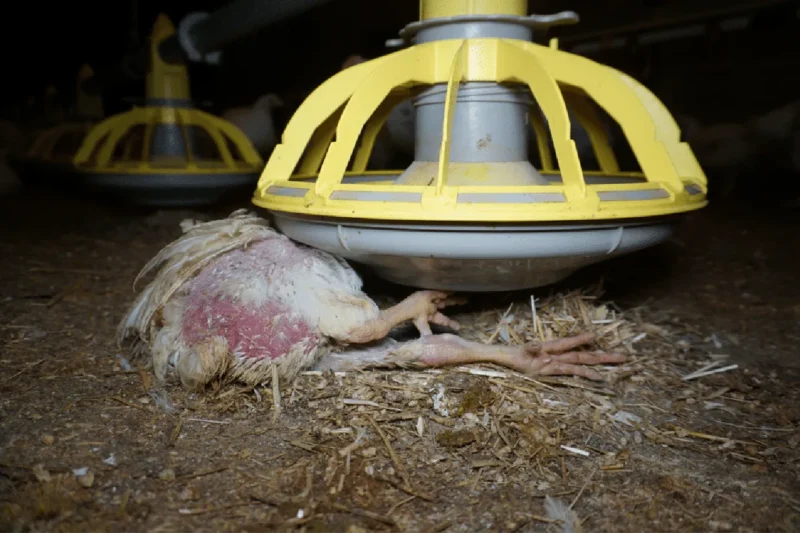
Tesco does not specify how much longer their “slower grown” chickens are allowed to live, which is a conspicuous omission on a label that asks consumers to pay a premium for better welfare. Based on the RSPCA Assured regulations, “enhanced welfare” indoor broiler chickens are typically killed at 45-60 days, compared to a minimum of 35 days for fast growing “Frankenchickens.” So let’s assume Tesco is happy that 45 days is “slower grown”, that’s an extra 10 days the birds get to live inside their filthy, crowded industrial barn. How incredibly generous.
“Slower grown” does not guarantee:
- meaningful space per bird
- natural behaviour opportunities
- natural light
- elimination of painful health issues
- freedom from mutilations
And nor does it deal with the air and water pollution generated by industrial chicken farms that blight communities and decimate wildlife.
Although slower grown chickens are still kept inside factory farms and harmed in countless ways, it is still a step in the right direction in terms chicken welfare. What a shame then that supermarkets like Sainsbury’s, ASDA, Morrisons, Lidl and Aldi, have not even bothered to try.
What They Don't Show You
Still permitted under this welfare term:
Who Uses This





The Bottom Line
Slower Grown” is better than buying Frankenchickens - to the tune of about 15 days of a chicken's life. But that’s like praising a system for slightly reducing the harm it designed.
Investigation and Reports
Take Action
-
 Frankenchickens
Ban Frankenchickens in the UK
Tell the Secretary of State at Defra to ban factory-farmed and fast-growing chickens known as Frankenchickens.
-
 Frankenchickens
Ask Your MP to Take Action
Ask why Frankenchickens are legal, when it’s unlawful to farm animals that will suffer because of how they have been bred.
-
 Factory Farming
End Factory Farming by 2040
It's time to bring it all down. Tell the government to block new factory farms and ban factory farming by 2040.
-
 Gas Chambers
Ban CO2 Gas Chambers for Pigs
Tell the Secretary of State at Defra to ban the use of CO2 gas chambers for pigs.
-
 Gas Chambers
Ask Your MP to Take Action
Ask why CO2 gas chambers are legal when the government’s Animal Welfare Committee recommends phasing them out?
-
 Gas Chambers
Tell Tesco to Drop CO2 Gas Chambers
Tell Tesco to stop selling meat from pigs killed in CO2 gas chambers, and commit to honest, transparent labelling.
-
 Gas Chambers
Tell McDonald’s to Drop Gas Chambers
Tell McDonalds to stop sourcing pork from pigs killed in CO2 gas chambers, and be transparent about slaughter methods.
-
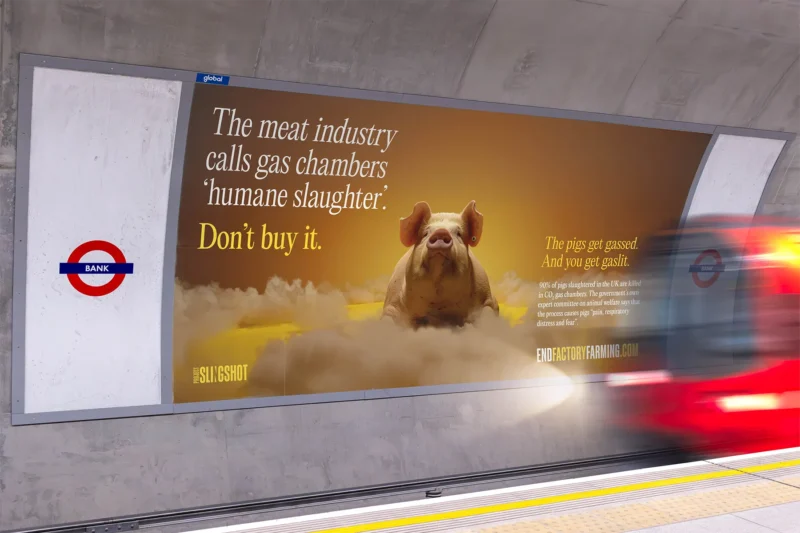 Donate
Power the Slingshot
Your monthly gift funds high-impact billboards, PR stunts, and campaigns that expose Big Ag and help us to bring down factory farming.