Skin Burns From Urine and Faeces
Burns are visible on chicken meat in supermarkets.
birds may be kept together inside a single shed.
fresh litter is introduced throughout their lifetime.
of chicken meat samples checked showed burns from the dirty litter.1
What It Is
Factory farms are disgusting places, and chickens may get the worst deal of all. Tens of thousands of birds are crammed inside each warehouse-style unit. There is nothing for them to do and nowhere to go. They are overbred to grow as big as possible as fast as possible and that means all they can do is eat, grow, and excrete waste.
Inevitably, the waste builds up and the birds – many of whom are lame because of their unnaturally ballooning bodies – have no option but to sit in it, stand in it, and try to sleep among it if they can.
That waste is full of ammonia. It is an alkali that causes painful burns, blisters, and ulcers on the birds’ skin and there is nothing they can do to escape it. These burns are a clear sign of poor welfare and a strong indicator of the suffering inflicted inside factory farms. If you’ve ever noticed a black mark on chicken meat, that’s probably what it is.
The industry calls them “hock burns” but really they are piss burns.
What They Do
Sensitive Content
This video contains content that some people may find upsetting
Impact
Painful
Millions of chickens in the UK must live in an environment where their skin is burned and blistered.
Infections
With their skin ulcerating, there is a greater risk of abscesses forming.
Unacceptable
No animal should be forced to live in such disgusting conditions.
Hall of Shame


Investigation and Reports
KFC admits a third of its chickens suffer painful inflammation
Hock burn is a silent crisis in chicken welfare
Aldi, Lidl and Sainsbury’s break silence over burnt chickens living in their own waste
Take Action
-
 Frankenchickens
Ban Frankenchickens in the UK
Tell the Secretary of State at Defra to ban factory-farmed and fast-growing chickens known as Frankenchickens.
-
 Frankenchickens
Ask Your MP to Take Action
Ask why Frankenchickens are legal, when it’s unlawful to farm animals that will suffer because of how they have been bred.
-
 Factory Farming
End Factory Farming by 2040
It's time to bring it all down. Tell the government to block new factory farms and ban factory farming by 2040.
-
 Gas Chambers
Ban CO2 Gas Chambers for Pigs
Tell the Secretary of State at Defra to ban the use of CO2 gas chambers for pigs.
-
 Gas Chambers
Ask Your MP to Take Action
Ask why CO2 gas chambers are legal when the government’s Animal Welfare Committee recommends phasing them out?
-
 Gas Chambers
Tell Tesco to Drop CO2 Gas Chambers
Tell Tesco to stop selling meat from pigs killed in CO2 gas chambers, and commit to honest, transparent labelling.
-
 Gas Chambers
Tell McDonald’s to Drop Gas Chambers
Tell McDonalds to stop sourcing pork from pigs killed in CO2 gas chambers, and be transparent about slaughter methods.
-
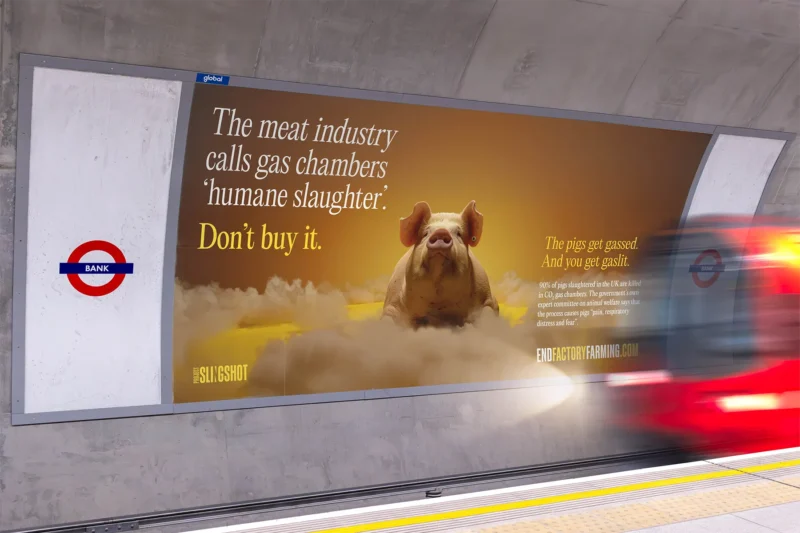 Donate
Power the Slingshot
Your monthly gift funds high-impact billboards, PR stunts, and campaigns that expose Big Ag and help us to bring down factory farming.