Tail Docking in Pigs
Cutting off piglets’ tails to stop them from getting bitten is cheaper than improving conditions.
of piglets1 have their tails cut off every year without anaesthetic.
of tail-docked pigs develop neuromas, which are associated with long-term nerve pain.3
of UK pig farms still thought to cut off tails even though routine docking is banned.4
What It Is
When intelligent, social, curious animals like pigs are forced to live in barren sheds with little room to move and nothing to do, frustration builds. Under these conditions, they sometimes bite each other’s tails. It is a clear sign of stress and boredom. But instead of giving the animals more space, some straw, and some stimulation, the industry has a much better answer: cut off their tails!
The industry prefers the benign term “docking” but it really means “amputating” or “slicing off”, and it is as painful a procedure as you might expect. It involves removing most of a piglet’s tail, usually with pliers or a hot cauterising iron, when they are just a few days old. No anaesthetic is legally required when conducting this mutilation, and not even any pain relief. The wound remains raw and highly sensitive for weeks, with many piglets developing infections.5 For some, it can lead to lifelong sensitivity.6
Farmers and industry bodies call this mutilation “a necessary management practice” but tail biting is not inevitable; it’s a symptom of the cruel conditions pigs on UK farms are forced to live in.
In 2006, the UK government banned the “routine” tail docking of pigs. Great news! Except, despite it being banned, it is estimated that up to 85 per cent of pigs in the UK still undergo this mutilation. How does the industry get away with it?
Well, the word “routine” functions as an exceptional get-out clause. The law says tail docking must be a last resort, not the first thing the industry tries. But if the conditions on farms make tail-biting inevitable, then nothing will stop tails getting infected except cutting off the tails. (Even then, tail infections are not exactly rare, and are often caused by the tail docking itself.) It is abundantly clear that it is the factory-farm conditions that are the problem.
In one study,7 a group of pigs was given a large plot of grassland, while a second group was given a plot of forestry of the same size. One of the most notable results the researchers found was “the almost complete absence of tail injury despite pigs being undocked.” There was just one minor case over the entire eight-week study. This is because the pigs had things to do, places to explore, and earth to root through. It’s not rocket science.
What They Do
Sensitive Content
This video contains content that some people may find upsetting
Impact
Painful
Nerve endings in piglets’ tails make this one of the most painful mutilations in animal agriculture.
Pointless
Docking fails to prevent tail biting when the underlying cause – stress – remains.
Preventable
Providing space, straw, and enrichment can eliminate the need for tail docking.8
Hall of Shame



Investigation and Reports
Tail docking is a "routine procedure" on UK Farms
Routine tail docking
Effects of environmental enrichment on the welfare of pigs
References
- 1. https://bvajournals.onlinelibrary.wiley.com/do/10.1002/vetr.00100143/full/#:~:text=The%20Animal%20Law%20Foundation%20stated,2.5%E2%80%934%20per%20cent'.
- 2. https://www.sciencedirect.com/science/article/pii/S1751731114002857#:~:text=Abstract,%CE%BCm;%20P%3C0.001).
- 3. https://www.sciencedirect.com/science/article/pii/S1751731116002500#:~:text=For%20example%2C%20abnormal%20spontaneous%20activity,docking%20method%20influenced%20neuroma%20formation.
- 4. https://bvajournals.onlinelibrary.wiley.com/do/10.1002/vetr.00100143/full/#:~:text=The%20Animal%20Law%20Foundation%20stated,2.5%E2%80%934%20per%20cent'.
- 5. https://pmc.ncbi.nlm.nih.gov/articles/PMC6917581/
- 6. https://www.sciencedirect.com/science/article/pii/S1751731116002500
- 7. https://www.pig-world.co.uk/news/highlighting-the-potential-for-successful-outdoor-pig-production-in-northern-ireland.html
- 8. https://www.sciencedirect.com/science/article/pii/S0168159125003636
Take Action
-
 Frankenchickens
Ban Frankenchickens in the UK
Tell the Secretary of State at Defra to ban factory-farmed and fast-growing chickens known as Frankenchickens.
-
 Frankenchickens
Ask Your MP to Take Action
Ask why Frankenchickens are legal, when it’s unlawful to farm animals that will suffer because of how they have been bred.
-
 Factory Farming
End Factory Farming by 2040
It's time to bring it all down. Tell the government to block new factory farms and ban factory farming by 2040.
-
 Gas Chambers
Ban CO2 Gas Chambers for Pigs
Tell the Secretary of State at Defra to ban the use of CO2 gas chambers for pigs.
-
 Gas Chambers
Ask Your MP to Take Action
Ask why CO2 gas chambers are legal when the government’s Animal Welfare Committee recommends phasing them out?
-
 Gas Chambers
Tell Tesco to Drop CO2 Gas Chambers
Tell Tesco to stop selling meat from pigs killed in CO2 gas chambers, and commit to honest, transparent labelling.
-
 Gas Chambers
Tell McDonald’s to Drop Gas Chambers
Tell McDonalds to stop sourcing pork from pigs killed in CO2 gas chambers, and be transparent about slaughter methods.
-
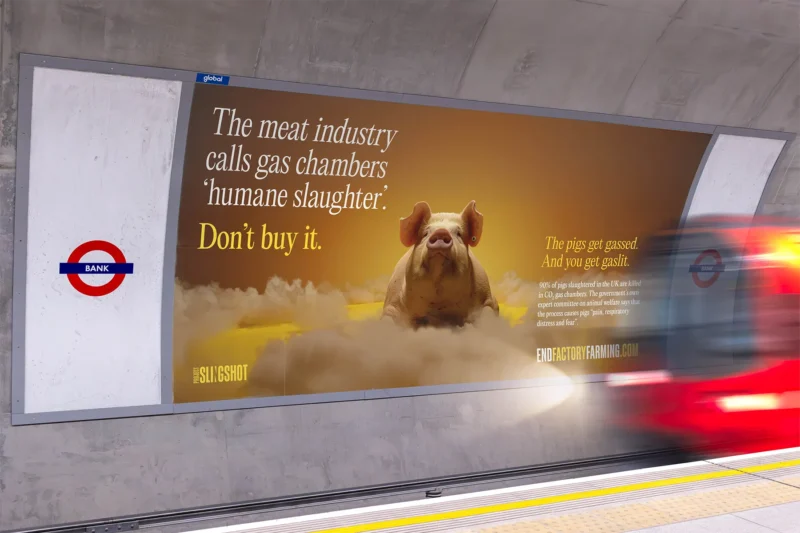 Donate
Power the Slingshot
Your monthly gift funds high-impact billboards, PR stunts, and campaigns that expose Big Ag and help us to bring down factory farming.