Organic
Animals raised in organic systems still face the same cruel end as any others in the farming system.
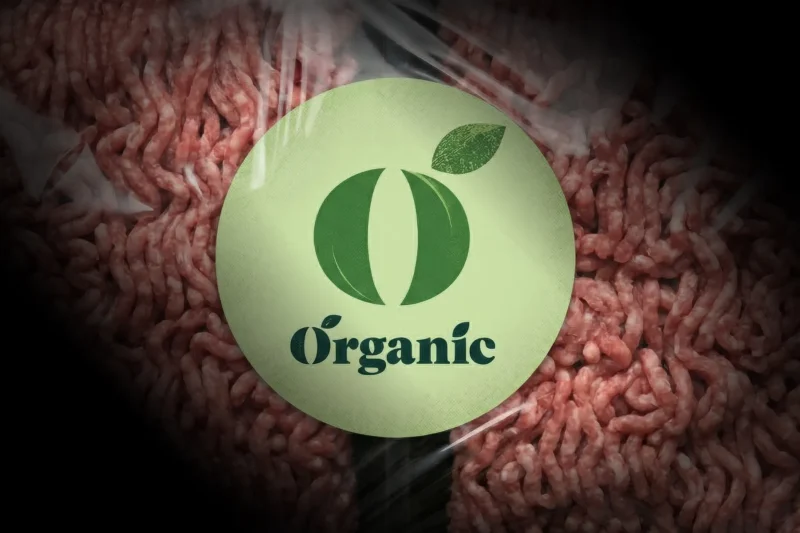
The Claim
They Say…
From organic farmers we trust
They Say…
Our organic cattle are farmed and reared in harmony with nature. They are selected for us by trusted farmers who rear them on an organic diet and encourage them to graze as nature intended
We Say…
And what about how those animals are killed?
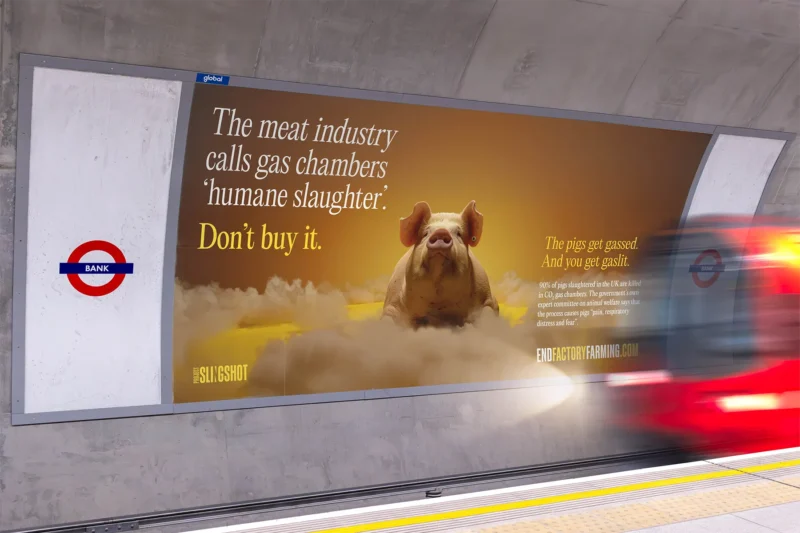
Animals raised in organic systems pass through the same industrial slaughterhouses and gas chambers as any other.
The Reality
If you want to sell organic food in the UK, you must be certified by an approved organic control body, such as the Soil Association. These bodies impose stricter welfare standards than conventional farming and require fewer antibiotics, which is a good thing, but very few animals are reared in this system. In the UK, just 0.3% of pigs are farmed organically, 1.5% of dairy cows, and 2.8% of poultry.1
Having higher standards does not necessarily mean having high standards. While organically farmed animals must have access to outdoor ranges, investigations have shown that indoor conditions can still be crowded and filthy, with little enrichment. Male chicks in the organic egg industry are still killed in hatcheries because they cannot lay eggs. Organic animals are still transported long distances to slaughter and killed at a fraction of their natural lifespan. Organic pigs and chickens are gassed in the same horrific CO₂ gas chambers as non-organic animals, and organic cows still pass through industrial stun boxes and bleed lines.2 Plus, organic animals produce as much waste as others, meaning air and water pollution outcomes are the same.
Like most accreditation schemes, organic standards are enforced through infrequent farm inspections which are typically planned, giving producers plenty of time to tidy up problem areas before inspectors arrive.3
Organic assurance certainly goes further than other accreditation schemes in terms of animal welfare. But that is not difficult when the bar is already so low.
What They Don't Show You
Still permitted under this label:
Who Uses This



The Bottom Line
If the standards are adhered to, organic is better than most, but higher standards are a very long way from being high standards.
References
- 1. https://www.gov.uk/government/statistics/organic-farming-statistics-2024/organic-farming-statistics-2024-united-kingdom#organic-livestock
- 2. https://www.soilassociation.org/media/gfldslub/soil-association-abattoir-slaughter-organic-standards-ni.pdf
- 3. https://www.animaljusticeproject.com/campaigns/milking-it
Take Action
-
 Frankenchickens
Ban Frankenchickens in the UK
Tell the Secretary of State at Defra to ban factory-farmed and fast-growing chickens known as Frankenchickens.
-
 Frankenchickens
Ask Your MP to Take Action
Ask why Frankenchickens are legal, when it’s unlawful to farm animals that will suffer because of how they have been bred.
-
 Factory Farming
End Factory Farming by 2040
It's time to bring it all down. Tell the government to block new factory farms and ban factory farming by 2040.
-
 Gas Chambers
Ban CO2 Gas Chambers for Pigs
Tell the Secretary of State at Defra to ban the use of CO2 gas chambers for pigs.
-
 Gas Chambers
Ask Your MP to Take Action
Ask why CO2 gas chambers are legal when the government’s Animal Welfare Committee recommends phasing them out?
-
 Gas Chambers
Tell Tesco to Drop CO2 Gas Chambers
Tell Tesco to stop selling meat from pigs killed in CO2 gas chambers, and commit to honest, transparent labelling.
-
 Gas Chambers
Tell McDonald’s to Drop Gas Chambers
Tell McDonalds to stop sourcing pork from pigs killed in CO2 gas chambers, and be transparent about slaughter methods.
-
 Donate
Power the Slingshot
Your monthly gift funds high-impact billboards, PR stunts, and campaigns that expose Big Ag and help us to bring down factory farming.