Red Tractor
The industry's favourite factory-farming fig leaf.
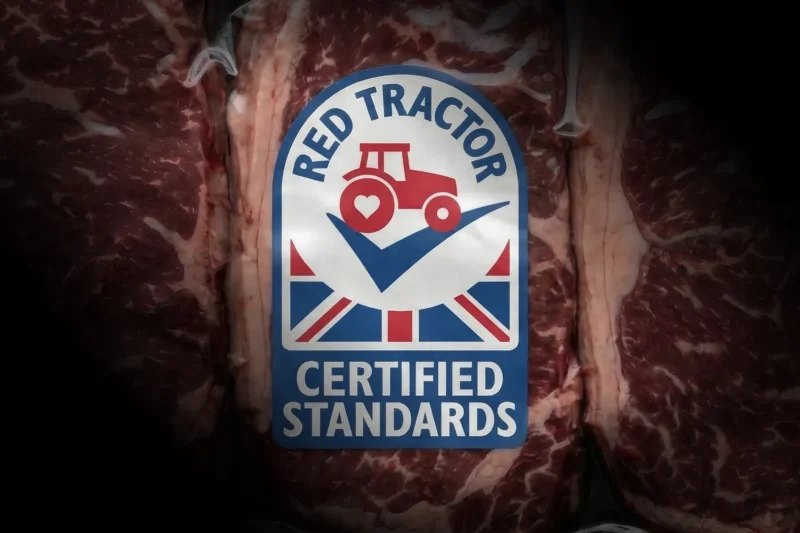
The Claim
They Say…
Great British food we can all be proud of.
They Say…
Food produced to standards you can trust.1
We Say…
Factory farming, farrowing crates, Frankenchickens, overcrowding, disease, death, antibiotics, tail docking, piglet thumping, water pollution. Red Tractor protects it all.
The Reality
Red Tractor is the most widely-used assurance label in British food production — and one of the most effective tools the UK meat, dairy, and egg industries have to make factory farming feel normal, regulated, and trustworthy.
It is owned and funded by the farming and food industry itself. Its “Ownership Body” includes the National Farmers’ Union, the Agriculture and Horticulture Development Board, Dairy UK, and the British Retail Consortium.2 The same industries that profit from the factory farming system are responsible for setting the standards that govern it.
In practice, Red Tractor standards largely reflect the bare legal minimum and what is commercially convenient for the industry. The scheme’s chicken stocking density of 38kg/m² is just one kilogram per square metre below the UK legal maximum of 39kg/m². That difference amounts to roughly the space of a post-it note per bird. Fast-growing chicken breeds that reach slaughter weight in 35-42 days — breeds prone to leg deformities, heart failure, and chronic pain — remain the Red Tractor standard.
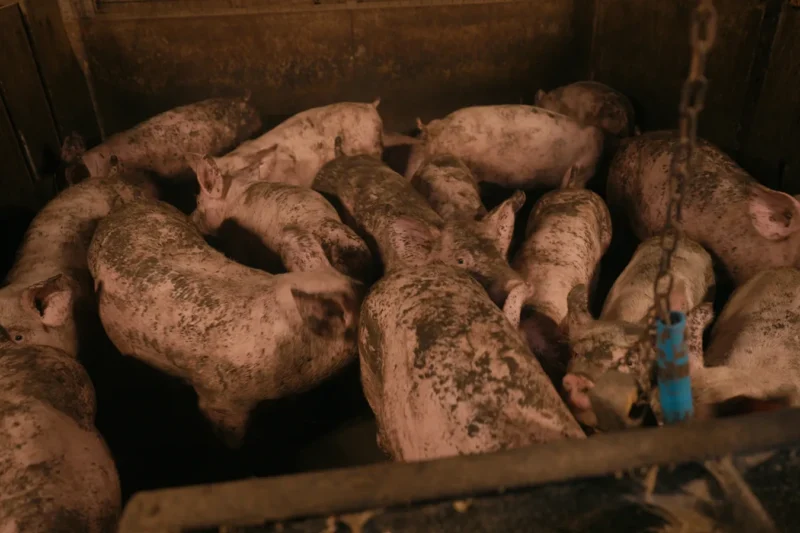
Red Tractor still permits pregnant pigs to be confined in farrowing crates for 5 weeks at a time, before , during, and after birth.3 These metal cages are so small that the sows cannot even turn around. Shockingly, a 2025 consultation found that 62% of producers did not want Red Tractor to set a cut-off date for ending the use of these cages. The industry voted to keep them.4 Multiple investigations into Red Tractor-approved pig farms have found truly abhorrent conditions, animal abuse, disease, death, cannibalism, and decay.5 6 Red Tractor pigs are gassed to death inside CO2 chambers.
In October 2025, the Advertising Standards Authority ruled that Red Tractor’s claim that food is “farmed with care” and that “all our standards are met” was misleading.7 The ruling cited Environment Agency data showing Red Tractor farms were actually more likely to pollute than non-certified farms and were responsible for 62% of the most serious pollution incidents between 2014 and 2019.8
What They Don't Show You
Still permitted under this label:
The Enforcement Gap
Red Tractor conducts around 60,000 inspections per year but with nearly 50,000 farms to cover, that amounts to barely more than one inspection per farm per year, and the vast majority of those inspections are pre-announced. In 2018, it was revealed that only 1 in 1,000 inspections was unannounced.9
Investigations into Red Tractor farms keep uncovering animal abuse, suffering, and illegality that the scheme’s own inspectors fail to detect.10 11 12
Our advice: Never Trust the Tractor.
Who Uses This



The Bottom Line
Red Tractor does not mean an animal lived a good life. It means the paperwork was (probably) in order on the very rare occasion that an inspector showed up... having called ahead first. Obviously. Investigations repeatedly show what happens the rest of the time.
It is not a mark of kindness or care, but a badge that normalises and protects industrial farming.
Investigation and Reports
Calls for legal action after ‘unimaginable suffering’ filmed at Devon pig farm
Red Tractor: What Does It Mean?
Watchdog rules Red Tractor exaggerated its environmental standards
References
- 1. https://redtractor.org.uk/
- 2. https://redtractorassurance.org.uk/wp-content/uploads/2024/07/member-matters-june-2024.pdf
- 3. https://farmsnotfactories.org/red-tractor-improve-your-standards
- 4. https://nationalpigassociation.co.uk/the-farrowing-debate-whats-the-latest/
- 5. https://www.theguardian.com/world/2024/mar/10/calls-for-legal-action-after-unimaginable-suffering-filmed-at-devon-pig-farm
- 6. https://viva.org.uk/red-tractor-overview
- 7. https://www.bbc.co.uk/news/articles/cx2lmnvj3n5o
- 8. https://www.theguardian.com/world/2025/oct/15/watchdog-rules-red-tractor-exaggerated-environmental-standards
- 9. https://www.theguardian.com/environment/2018/sep/24/alleged-beatings-abuse-uk-pig-farms
- 10. https://www.theguardian.com/world/2024/mar/10/calls-for-legal-action-after-unimaginable-suffering-filmed-at-devon-pig-farm
- 11. https://www.bbc.co.uk/news/articles/c5y32e9484no
- 12. https://www.bbc.co.uk/news/articles/cqlk2d3elp9o
Take Action
-
 Frankenchickens
Ban Frankenchickens in the UK
Tell the Secretary of State at Defra to ban factory-farmed and fast-growing chickens known as Frankenchickens.
-
 Frankenchickens
Ask Your MP to Take Action
Ask why Frankenchickens are legal, when it’s unlawful to farm animals that will suffer because of how they have been bred.
-
 Factory Farming
End Factory Farming by 2040
It's time to bring it all down. Tell the government to block new factory farms and ban factory farming by 2040.
-
 Gas Chambers
Ban CO2 Gas Chambers for Pigs
Tell the Secretary of State at Defra to ban the use of CO2 gas chambers for pigs.
-
 Gas Chambers
Ask Your MP to Take Action
Ask why CO2 gas chambers are legal when the government’s Animal Welfare Committee recommends phasing them out?
-
 Gas Chambers
Tell Tesco to Drop CO2 Gas Chambers
Tell Tesco to stop selling meat from pigs killed in CO2 gas chambers, and commit to honest, transparent labelling.
-
 Gas Chambers
Tell McDonald’s to Drop Gas Chambers
Tell McDonalds to stop sourcing pork from pigs killed in CO2 gas chambers, and be transparent about slaughter methods.
-
 Donate
Power the Slingshot
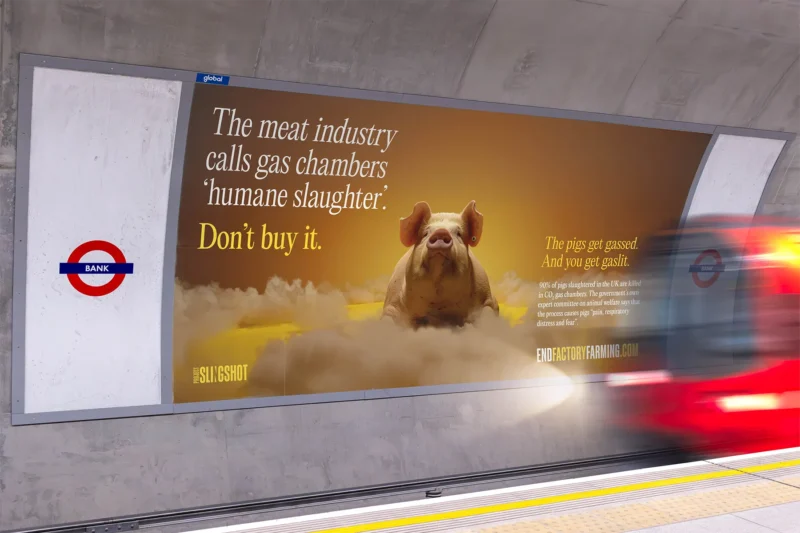
Your monthly gift funds high-impact billboards, PR stunts, and campaigns that expose Big Ag and help us to bring down factory farming.