Heavy Metal Contamination in Farmed Fish
But not just farmed fish, wild fish too.
of mercury intake in a group of people studied came from eating fish.1
that’s the percentage of fish that contained mercury and cadmium when tested for one 2020 study.2
the ideal amount of heavy metals in our diets.
What It Is
In a process known as “bioaccumulation”, fish ingest and store compounds in their flesh. This can include toxic chemicals like PCBs, PBDEs, dioxins, microplastics, and pesticides, and it can also include heavy metals like lead, mercury, arsenic, and cadmium. When we eat fish, the toxic compounds in their bodies transfer to our own.
Both wild fish and farmed fish accumulate heavy metals but the amounts vary with the type of fish and the waters they swam in. Research shows that traces of arsenic may be higher in farmed salmon than in wild, but cadmium may be higher in wild salmon than farmed.3 Mercury has been found in both farmed and wild fish,4 though in greater amounts in the wild.
The fish in UK supermarkets is imported from all over the world, so it is impossible to say which fish swam where, and it is impossible to know without testing each fish individually what heavy metals are in their bodies.
What we do know is that the optimal amount of heavy metal to ingest is zero because those heavy metals accumulate in our bodies, too, and are linked to diseases such as diabetes, cardiovascular diseases, cancer, and neurodegeneration.5 There are other, safer ways to get our omega-3s.
What They Do
Sensitive Content
This video contains content that some people may find upsetting
Impact
Toxic
Fish accumulate toxins from the waters they swim in.
Filthy
Fish farms are filthy places, where fish swim in a toxic soup of lice, disease, and chemicals.
Disease
Ingesting heavy metals is associated with a number of chronic diseases.
Hall of Shame


Investigation and Reports
Fish and seafood safety: Human exposure to toxic metals from the aquatic environment and fish in Central Asia
Heavy metals in commercial fish and seafood products and risk assessment in adult population in Bosnia and Herzegovina
Heavy metal risks in aquatic foods
References
- 1. https://pmc.ncbi.nlm.nih.gov/articles/PMC5036710/
- 2. https://www.nature.com/articles/s41598-020-70205-9
- 3. https://www.healthline.com/nutrition/wild-vs-farmed-salmon#Wild-caught-salmon-vs-farmed-salmon
- 4. https://link.springer.com/article/10.1007/s12011-024-04493-x
- 5. https://pmc.ncbi.nlm.nih.gov/articles/PMC10313886/
Take Action
-
 Frankenchickens
Ban Frankenchickens in the UK
Tell the Secretary of State at Defra to ban factory-farmed and fast-growing chickens known as Frankenchickens.
-
 Frankenchickens
Ask Your MP to Take Action
Ask why Frankenchickens are legal, when it’s unlawful to farm animals that will suffer because of how they have been bred.
-
 Factory Farming
End Factory Farming by 2040
It's time to bring it all down. Tell the government to block new factory farms and ban factory farming by 2040.
-
 Gas Chambers
Ban CO2 Gas Chambers for Pigs
Tell the Secretary of State at Defra to ban the use of CO2 gas chambers for pigs.
-
 Gas Chambers
Ask Your MP to Take Action
Ask why CO2 gas chambers are legal when the government’s Animal Welfare Committee recommends phasing them out?
-
 Gas Chambers
Tell Tesco to Drop CO2 Gas Chambers
Tell Tesco to stop selling meat from pigs killed in CO2 gas chambers, and commit to honest, transparent labelling.
-
 Gas Chambers
Tell McDonald’s to Drop Gas Chambers
Tell McDonalds to stop sourcing pork from pigs killed in CO2 gas chambers, and be transparent about slaughter methods.
-
 Donate
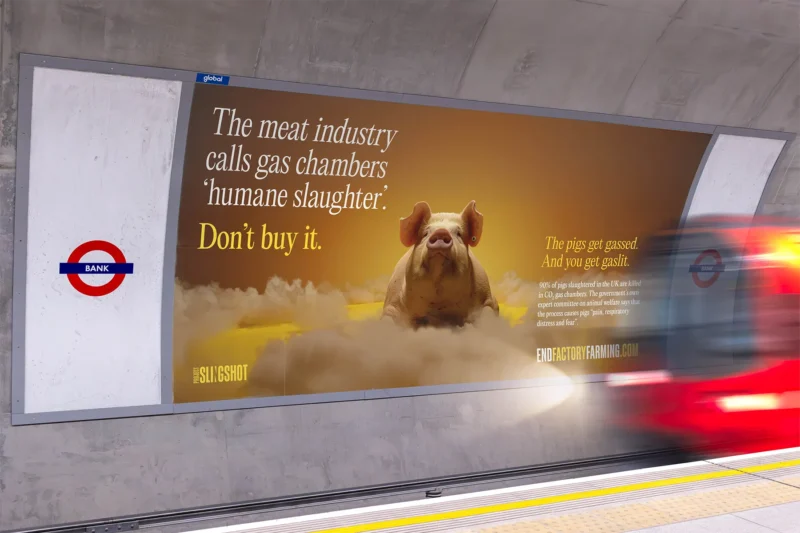
Power the Slingshot
Your monthly gift funds high-impact billboards, PR stunts, and campaigns that expose Big Ag and help us to bring down factory farming.