Is Slingshot working?
An honest answer, five months and two campaigns in.
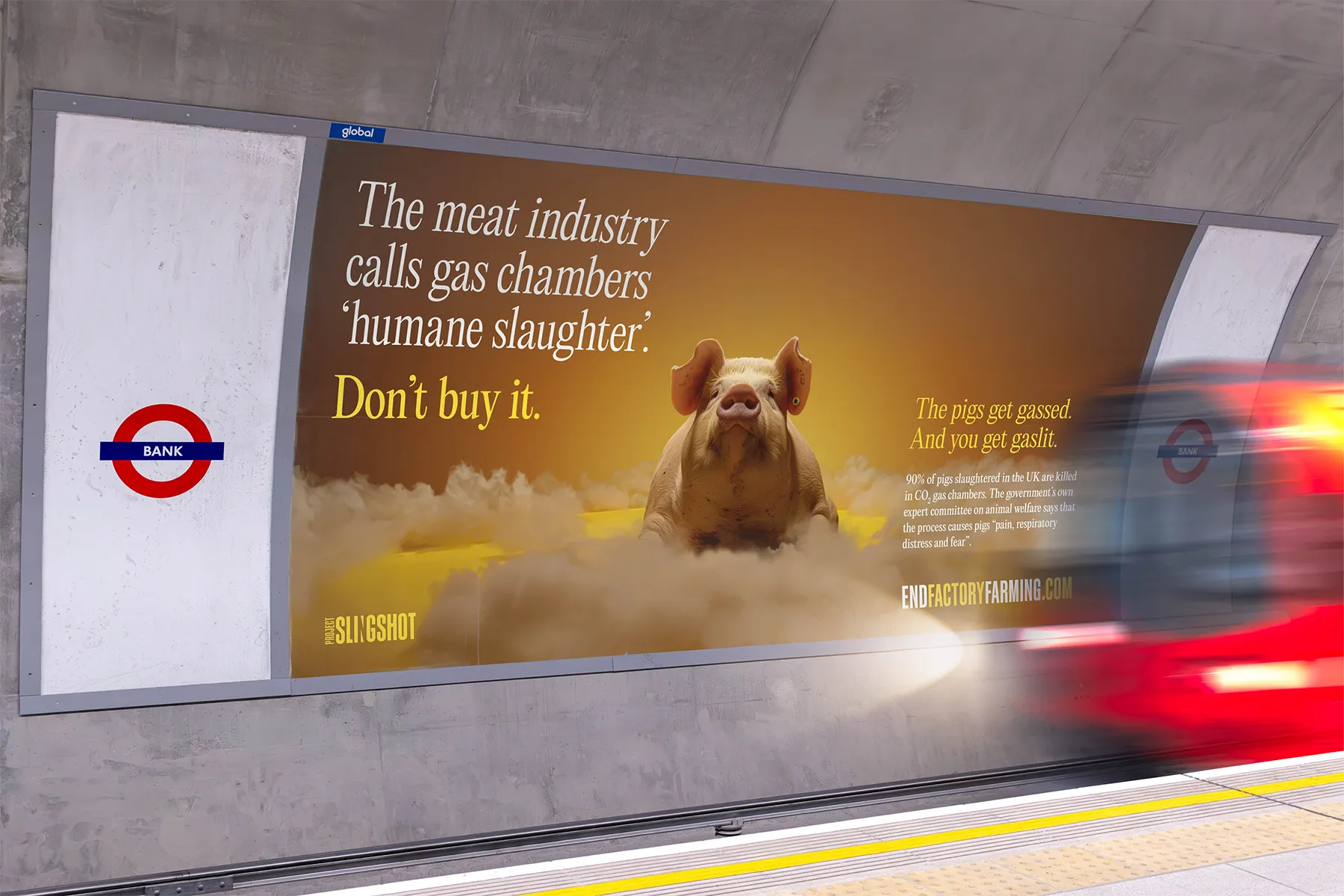
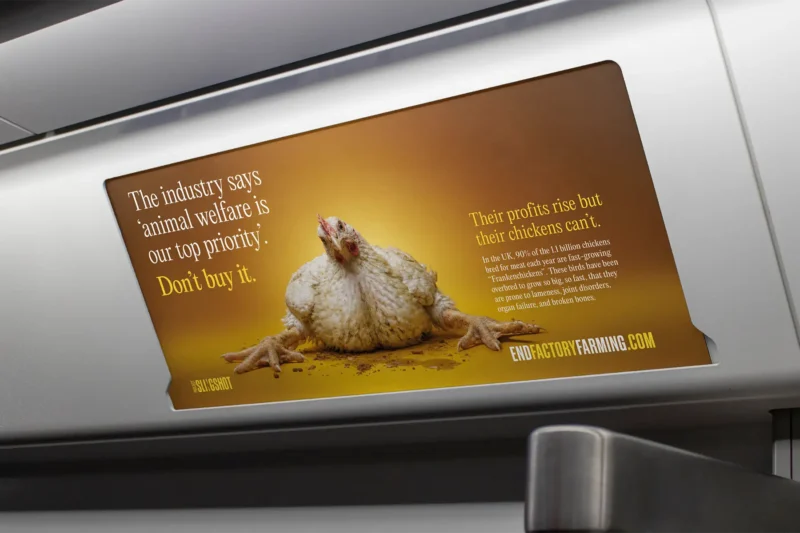
Five months ago we launched Project Slingshot in the UK, to drag the truth about factory farming into the light. Since then, we’ve put pigs choking in gas chambers and chickens too big to walk on the walls of the London Underground, where millions of commuters couldn’t look away.
But is it working?
That depends on what you mean by “working”. If the test is whether gas chambers have been banned yet, or retailers have stopped selling Frankenchickens, then no. But those aren’t the primary signs of progress we’re looking for.
Our first campaigns were designed to take cruel and hidden practices and make them impossible to ignore; to turn that attention into pressure on the companies and politicians who keep it going; and to start making factory farming as a whole harder to defend.
Since our launch, millions of people have seen our ads online and on the London Underground, tens of thousands have written to companies and politicians, more than 200 MPs have written back (most of them in support of ending CO₂ slaughter), the UK’s biggest pork company has switched off their comments rather than respond, and an independent survey shows that people who saw the posters now know more about the issue.
The evidence we have so far points to our theory of change working as intended, at least in the first stages. Where we’re not having as much traction as we hoped, we’re learning why.
Slingshot is a major experiment. The meat industry spends billions telling people what to eat, while the counter-argument has barely been funded at all. No one has tried to make factory farming socially and politically indefensible on this scale before. We’re testing what happens when our movement finally goes big and bold. That means having room to try things, get some of them wrong, and learn from what doesn’t work. We’re asking for the same patience funders gave corporate campaigns and alternative proteins: the time and money to test, fail and try again.
We’re determined to keep producing audacious campaigns, and our approach is simple: always on, always adding.
If you read nothing else, here’s what our evaluation has found:
- We’re reaching beyond the bubble. Social Change Lab’s polling found that around 1 in 4 Londoners remembered the campaign, about three times the national rate, with the Underground ads playing a big role. And people who already cared about factory farming were no more likely to remember it than anyone else, so we’re not just preaching to the converted.
- Attention is turning into pressure. Voters have now contacted MPs in 646 of the 650 constituencies, and more than 200 MPs, nearly a third of the House of Commons, have written back in support. Supporters have taken over 140,000 digital actions in total, and the companies we named mostly went quiet rather than defend themselves.
- People learned the specific thing we told them. Asked what share of British pigs are gassed, people who hadn’t seen the campaign guessed 54% and those who had guessed 70%, getting closer to the real figure of around 90% the more of it they’d seen. That matters because the industry relies on people not knowing, and once they know, most object: two thirds of those who’d seen the campaign called gas chambers cruel.
- Opposition isn’t the problem. Inaction is. Around three quarters of the British public opposed factory farming before we existed and still does. Support for a factory farming ban rose, but we found no link to our campaign specifically. Our job is to turn that quiet opposition into pressure that companies and politicians have to answer.
- We’re learning what works, and what doesn’t. The Frankenchickens campaign landed with less force than gas chambers, mainstream press hasn’t taken off, grassroots coordination slipped, and the handover to partners needed more careful attention. We know what we’d do differently on each, and we’ll come back to that below.
- The big bet is still open. Stripping an industry of its social licence takes years, not months. Tobacco took decades, although campaigns like the one by America’s “Truth Initiative” showed measurable results within two to three years, with policy wins along the way. We’ve set out what we’ll measure in the meantime, and what would prove us wrong.
Part one: what we do
Making factory farming indefensible
Slingshot has one goal: to strip factory farming of its social licence, so that the whole system, rather than any one practice, becomes culturally and politically indefensible. Around three quarters of the British public already say they oppose it, and they have for years, which is exactly why we chose it as our target. Ask people to give up meat and you’re arguing with the majority, but ask them whether pigs should be gassed or chickens bred until their legs give way, and the majority is already on your side. The system survives because it’s hidden, treated as normal, and rarely questioned, and our job is to change that. We don’t tell people what to eat. Our tagline “Don’t buy it” means don’t buy the industry’s story: the labels, the adverts, the idea that any of this is normal. What people do once they stop believing that story is up to them. Changes in shopping habits, policy and investment follow from that, not the other way round.
One practice at a time, against the whole system
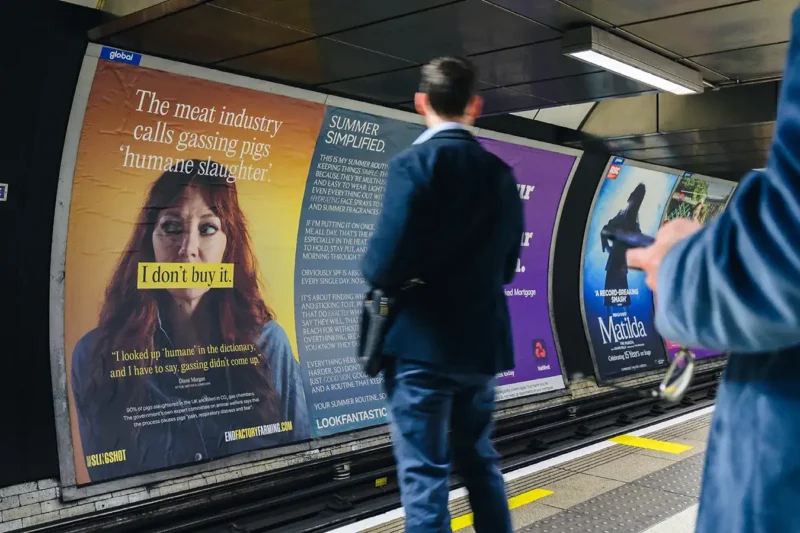
We do this through “drumbeats” – concentrated campaigns that take a single practice, put it in front of millions of people, name the companies that profit from it, and give people simple ways to hold those in power to account. We combine ads on the London Underground with provocative social media content, celebrity and influencer partnerships, original documentaries, and the occasional PR stunt (like the time we projected slaughterhouse footage onto Buckingham Palace).
A single, concrete practice is easier to grasp and harder to defend than “factory farming” in the abstract. So we move from one practice to the next, and from one company to another, showing that these aren’t isolated problems. As we said in our launch video: it’s not one bad apple. It’s the whole fucking orchard.
The first drumbeat was on CO₂ gas chambers, the method used to kill around nine in ten British pigs, which the government’s own advisory body said was unacceptable in 2003, yet remained largely unknown to the public more than twenty years later. The second was Frankenchickens, the fast-growing breeds that make up the overwhelming majority of the 1.1 billion chickens raised for meat in the UK each year. The third, launching on 5 October, is farmed salmon.
Every drumbeat is built on the same two ideas: deception, meaning you’ve been lied to about this for years, and disgust, meaning this is filthier and more squalid than the labels and adverts suggest. Deception creates distrust, and each practice we expose is another proof point against the whole system.
We’re a pressure engine
Despite our coverage of issues like CO2 gas chambers and Frankenchickens, Slingshot doesn’t run campaigns to win welfare improvements and we’re not the people who negotiate them. A welfare reform can reduce suffering and we’re glad when it does. But when the industry presents each reform as proof that the problem is being solved, it can distract from the bigger picture.
Our job is to keep showing people that bigger picture. Each practice we expose is a window into the system, not an end goal. Each one shows what the industry does when nobody is watching, and what the whole system relies on to function. Ending them would matter, but our real aim is to move the question from “how do we fix this practice?” to “how do we end factory farming?” When big tobacco first came under pressure, its answer was the filter and the “light” cigarette: products that looked safer without being safer, and that bought the industry decades. Slingshot has no interest in helping the meat industry find its filter.
We don’t negotiate with companies, lobby politicians, take anyone to court or sell alternatives. Plenty of other organisations do those things, many of them brilliantly, and we’ll need all of it to end factory farming. What that work has rarely had behind it is sustained public pressure on a large scale, with serious money to back it. That’s what we’re trying to build, so that when a corporate campaigner makes an ask, the company is already rattled, and when a lobbyist walks in to see an MP, the MP’s inbox is already full.
Our theory of change
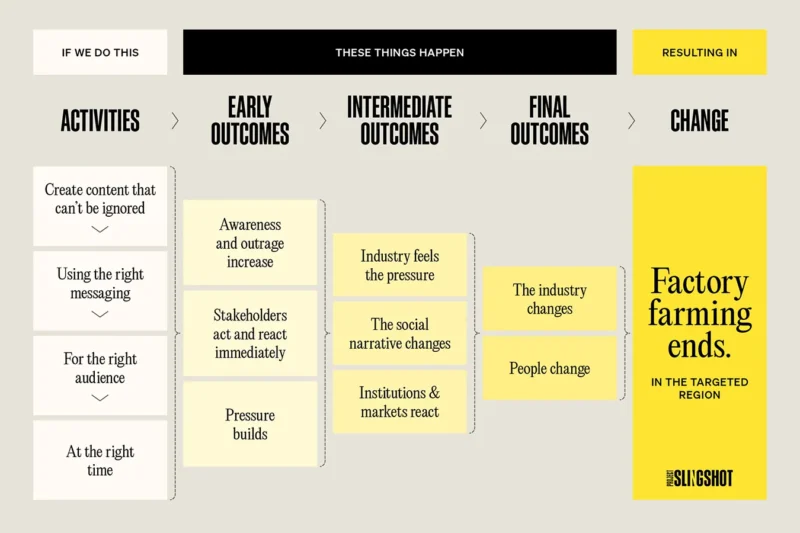
Here’s how we envision our path to impact:
People see the content, react and act → pressure builds in politics, in press, and in supply chains → the social narrative shifts and the industry feels it → policy, investors and consumer demand follow.
We drew it this way because we don’t want to judge ourselves only on our own activity. Views, signatures and press coverage matter, but they tell us how many people we’ve reached, not whether anything has changed. The real test is further down the line: is factory farming becoming harder to defend, and are we helping to make that happen?
Success is factory farming becoming a dinner-table issue.
That means measuring more than video views and brand mentions. We’re trying to change how the public, companies and politicians see an entire industry, and that won’t happen neatly from one quarter to the next. Attitudes can stay stubbornly fixed for a long time, then shift surprisingly quickly. That’s why we believe so strongly in continuity and repetition. Ending factory farming is a marathon, not a sprint. We need to keep showing up, keep making the case and keep adding to the pressure.
So how do we know if any of this is working? Campaigns chasing a specific policy usually know when they win. We don’t get that clarity. When the goal is to make a whole system indefensible, there’s no single finish line to tell you you’re on track, and it becomes easy to mistake activity for progress, or to drift towards whatever gets the warmest response in the comments or attracts funding most easily. So we’re looking for the early signs that should appear if our theory is right. We’ll be honest when they don’t, and change what we’re doing when we need to.
With that in mind, we assess four pillars for every drumbeat:
- Salience: Is the issue becoming more visible, and are people describing it in our language, like “gas chambers” and “Frankenchickens”?
- Legitimacy collapse: Is it harder to defend in public, judged by independent surveys and by whether industry voices defend it, go quiet, or reconsider?
- Market movement: How are companies responding under pressure, and are retailers, suppliers and investors starting to treat these practices as a risk?
- Political conversion: Are politicians starting to take a side? Are MPs going on record, raising the practice in Parliament, and treating it as an issue they have to answer for?
Campaign analytics tell us we’re reaching people; only these four questions tell us whether the reach is creating change. Wherever possible, we don’t mark our own homework: Social Change Lab runs our polling, with a baseline taken in September 2025 before we existed publicly, and independent retail sales data will tell us whether anything changed in people’s shopping baskets.
A note on why we track what we don’t control
We’ve said we’re not the lobbyists and we don’t negotiate with companies, so why does this report look at parliamentary debates and corporate behaviour at all? Because that’s where our work is meant to land. Campaigners call this the inside-outside game: we build public power from the outside, in the form of voters, attention and a narrative that doesn’t fade when the press moves on, and the people on the inside use it in their negotiations with companies and government. We don’t expect credit for those wins, and we shouldn’t be judged on whether they happen within one campaign. But if our pressure never shows up there, something in our model isn’t working.
Part two: how it’s going
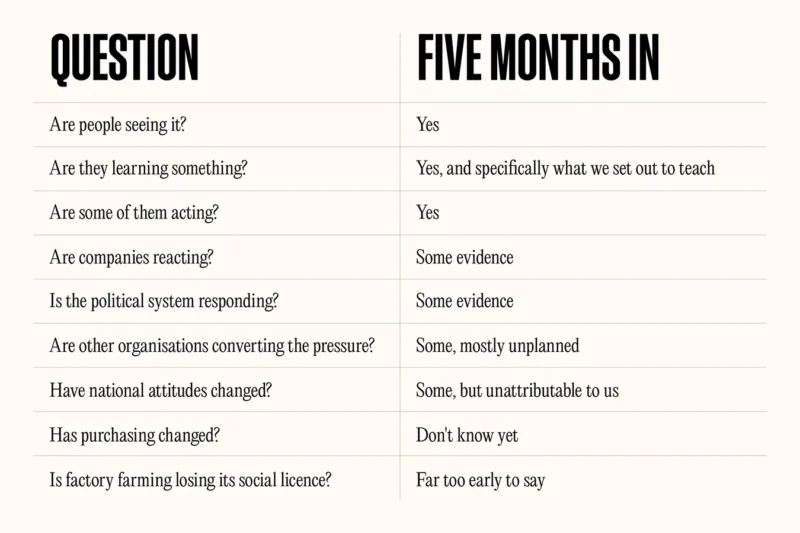
Here’s where we are, five months in. The further down the table you go, the less evidence we have, which is to be expected this early on. The early links are the ones that we’ve focused on with our first two campaigns.
People saw it, and the Tube was a major driver
Social Change Lab’s July 2026 survey, run independently and weighted to be nationally representative, found that around 1 in 9 UK adults had heard of the campaign after one drumbeat, most of them “a little.” Based on the adult population in the UK, that equates to around 6 million people.
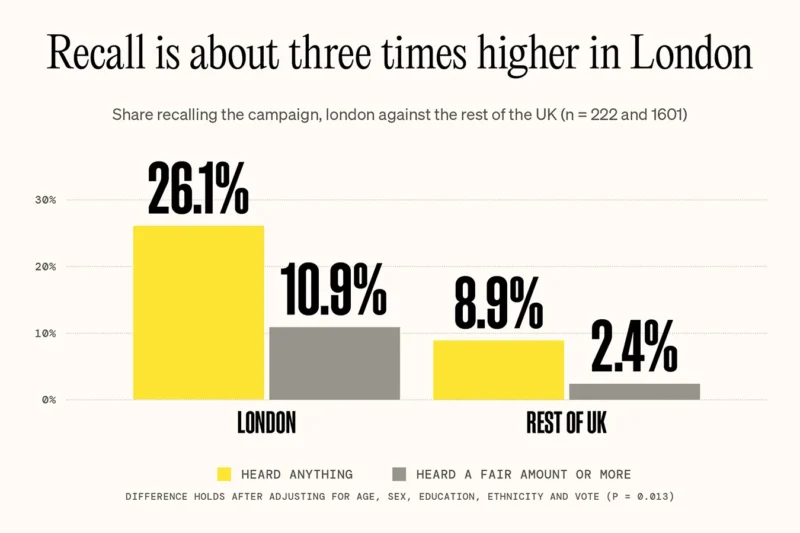
London recall was three times the rest of the country, and among Londoners who had seen the campaign, 58% named the Underground as where they saw it. About 20% of them said they’d heard about it from friends and family, indicating that the Tube ads generated conversation. For a two-month campaign in one city, we read that as a strong signal the channel is doing its job.
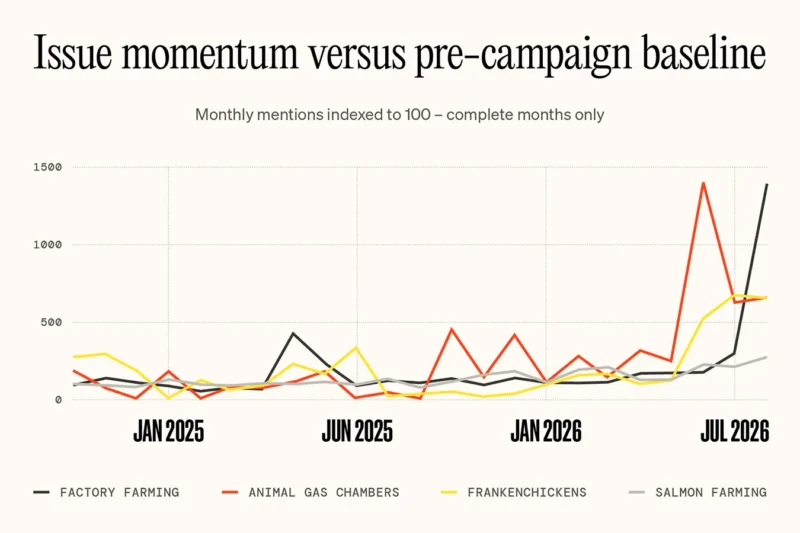
Our social listening data from Onclusive, a global media monitoring platform, tells a similar story. Conversation about factory farming is growing, and discussion of each practice rose sharply during its drumbeat, although from a low base, since neither was widely talked about before we started. The two campaigns behaved differently afterwards: gas chambers spiked sharply and fell away once the campaign ended, while Frankenchickens peaked lower but seems to be holding at a higher level. A big spike shows we can get people talking, but the bigger question is whether we can keep them talking. We’re watching closely to see whether short, intense drumbeats or a steadier, continuous campaign does that better.
It’s worth noting that Slingshot wasn’t driving any of these conversations alone – other organisations have been campaigning beside us during each drumbeat, and for many years prior. Notably, Anima’s £1m campaign on Pret’s broken chicken commitment aligned with our Frankenchickens drumbeat, and Animal Rising’s action in Trafalgar Square contributing to the “factory farming” interest spike.
They learned the specific thing we told them
When asked what proportion of British pigs are gassed, people who hadn’t seen the campaign guessed 54% on average; people who had seen it guessed 70%, against a true figure of around 90%. The more of the campaign people remembered, the closer they got, and the gain was concentrated on the campaign’s message rather than on general knowledge of farming. (That’s exactly what you’d expect if the campaign caused it.) People who already cared about animal issues were no more likely to remember the campaign than anyone else, so we’re reaching beyond our own bubble rather than preaching to it. And there was a tentative pattern, resting on small numbers, of campaign-aware people being more likely to name factory farming as one of the three biggest issues facing the country. Social Change Lab treats that as a hint to follow up rather than a result, and we agree.
Some of them acted
Between our launch in April and the end of our first campaign on 14 June, online supporters completed 83k digital actions: 43k signatures on the petition to ban CO2 gas chambers, 20k emails to Tesco, 12.5k to McDonald’s and 7.5k to MPs. For every petition signature, supporters sent close to one email to a named company or politician. That was a strong start. But we didn’t sustain it through the next drumbeat.
Digital actions taken during the Frankenchicken period, which ran for 12 weeks versus 8, were about half as much, totalling just under 40k. The chicken campaign reached a comparable weekly social audience but far fewer went on to take action. We continued gaining followers, views, and donors, but actions like emails and petition signatures fell.
Based on our theory of change, actions on our own platforms are a relatively shallow measure of what a drumbeat accomplishes. But we take them seriously, and our marketing and analytics team are strategising to improve the action architecture and creative to ensure that the next drumbeat hits or exceeds the baseline we set with Gas Chambers.
We’re also learning more about what makes people act. One week in July, we combined a clear villain, a piece of timely content and a single ask. The number of people writing to Pret about its chickens went from 51 to 1,835. That worked, and we need to get better at doing it consistently.
There may be a bigger lesson here, which we come back to below: an issue can matter enormously and still fail to move people to act.
The trade press noticed
The trade press is where the buyers, category directors and processors who actually make the decisions get a sense of what’s happening in their industry. If an issue keeps appearing in those pages, it starts to feel harder to ignore. And because these are the people making the decisions, that matters.
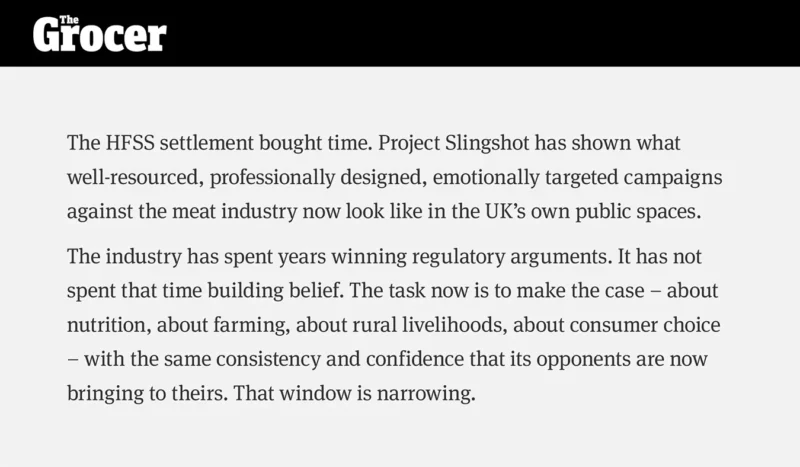
The Grocer covered our launch as news, ran a feature on our aim of making factory farming indefensible, published a letter from a food-industry chief executive engaging directly with our methods, covered the projections onto Parliament and Buckingham Palace, and in June asked whether the meat industry is approaching its “tobacco moment”.
The tobacco analogy is our delegitimisation thesis, appearing in the industry’s own trade press during our campaign window, positioning Project Slingshot as a “consistent and confident” opponent of industry.
Companies responded, with silence or defensiveness
Throughout the campaigns, we directed hundreds of our supporters into the comment sections for companies like Cranswick – Tesco’s principal pork supplier – and McDonald’s UK. Cranswick promptly disabled comments across its profiles and blocked us from tagging it. As of September, those comments are still turned off across all platforms. McDonald’s UK added “gas chambers” to its moderation blocklist, so supporters found creative spellings to keep asking the question, leaving more than 1,000 comments in total. McDonald’s also became a regular viewer of our Instagram stories, apparently to keep an eye on what we’d do next.
Similarly, Red Tractor – the UK’s main farm assurance scheme – also added the word “Frankenchicken” to their own blocklist after Slingshot supporters started commenting.
In August, Adfree Cities launched Gag Big Ag, a coalition campaign calling for an end to advertising for factory-farmed food. The Association of Independent Meat Suppliers (AIMS) replied to the launch post with “Remove the Slingshot billboards as well then” and went on to argue publicly that factory farming is here to stay. Its policy director later used a column in Poultry Business to call our campaign “ethnocentric” but at no point did he try to defend Frankenchickens.
These can look like small wins. A deleted comment section isn’t a policy change, and a defensive reply from a trade body isn’t a concession. But we aren’t negotiating with these companies, and we don’t need them to agree to anything. We just need evidence that the practice has become hard to defend in public, and these are some early indicators. This is the ground that future policy wins and market shifts are built on.
The public reached Parliament
By September, more than 13,000 people had emailed their MP through our site, reaching MPs in 646 of the 650 constituencies. Over 200 MPs have responded or acted, 85% of them supportively, putting more than 160 on record in favour of ending CO2 slaughter; the rest sent neutral or standard replies, and one was hostile.
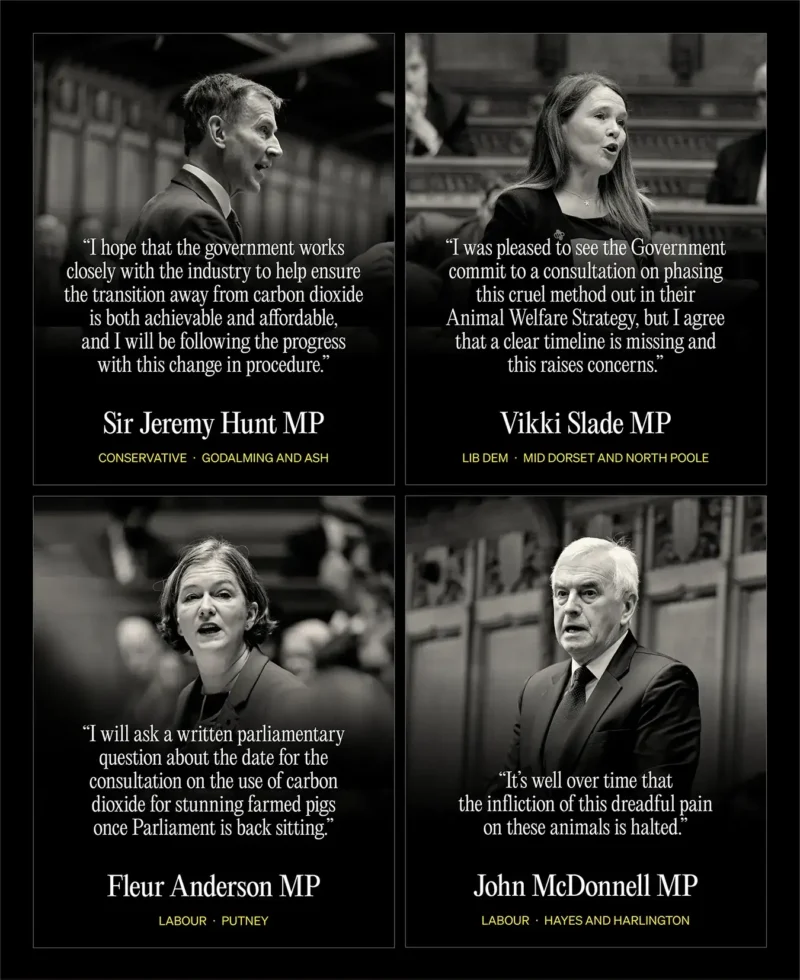
That support has come from across the House. Two Liberal Democrat MPs, Danny Chambers and Edward Morello, received constituent emails sent through our website in April and May, and then raised CO₂ stunning in a Commons debate on 14 July. We can’t prove the emails alone prompted them, but this is exactly the kind of knock-on effect we’re looking for. In June, Green Party leader Zack Polanski joined our projection action in London, and Conservative MPs, including former Chancellor Sir Jeremy Hunt, have written to constituents backing the move away from gas chambers.
Cross party support matters. If factory farming becomes one party’s issue, the others will defend it. We want it to be indefensible for all of them, and support from Conservative, Labour, Lib Dem and Green MPs suggests gas chambers is getting there.
One funder who has watched a lot of campaigns unfold put it better than we could: the story moved from “we are reaching the public” to “the public is reaching decision-makers.” A senior Westminster lobbyist for one of the big animal charities wrote publicly this month that “quite a few MPs have mentioned seeing the campaign and that it’s effective.” We’ve heard anecdotally that “Defra is feeling the heat.”
We’re building on work that started long before us. RSPCA and Compassion in World Farming have spent years asking the government to deliver its promised consultation on pig slaughter, and we claim no credit for that. What we can see though, is some evidence that we’re changing their audience. The MPs they’re talking to have seen the Slingshot posters on their way into Westminster, and most have now heard about gas chambers from their own voters, which makes an old ask much harder to brush off. They do the lobbying; we make sure nobody can say “we didn’t know.”
Other organisations are converting the pressure
UK Voters for Animals is running a mass lobby day on Frankenchickens on 10 November and says openly that it’s building on the attention our campaign generated. Anima International’s campaign against Pret ran alongside our Frankenchicken drumbeat. Animal Justice Project’s “Turn Off The Gas” tanker tour and its private prosecutions of Cranswick ran through June, and when the Daily Mail reported Cranswick’s chief executive receiving a £5.3 million pay package, the coverage drew on the pressure both campaigns had built. These organisations are independent of Slingshot, and we didn’t plan most of what happened. That’s starting to change. On 19 October we’re joining Foodrise, Communities Against Factory Farming and River Action for a lobby day in Parliament, co-hosted by Labour, Green and Liberal Democrat MPs, where supporters will meet their own MPs to call for a moratorium on new factory farms and a commitment to end factory farming in the UK.
And it reached well beyond the movement
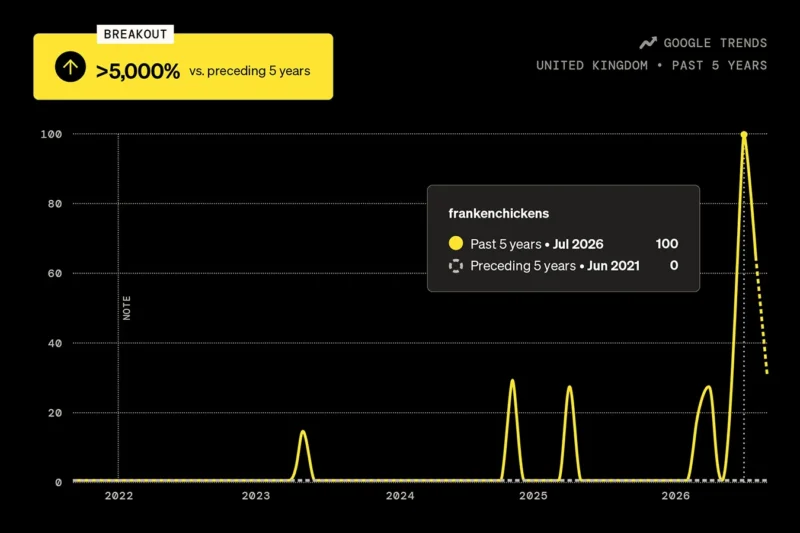
Our combined social views grew from about 29M for Gas Chambers to 54M for Frankenchickens. We’ve had over 100 pieces of press coverage as of September with a combined audience of over 25M; UK Google searches for “frankenchickens” are having a breakout moment, when before this summer the term barely registered; and a Guardian food columnist wrote in July that she’d been “gobsmacked by Project Slingshot” for “moving the debate from ‘Should people eat meat?’ to ‘Should animals be raised in industrial conditions?'”
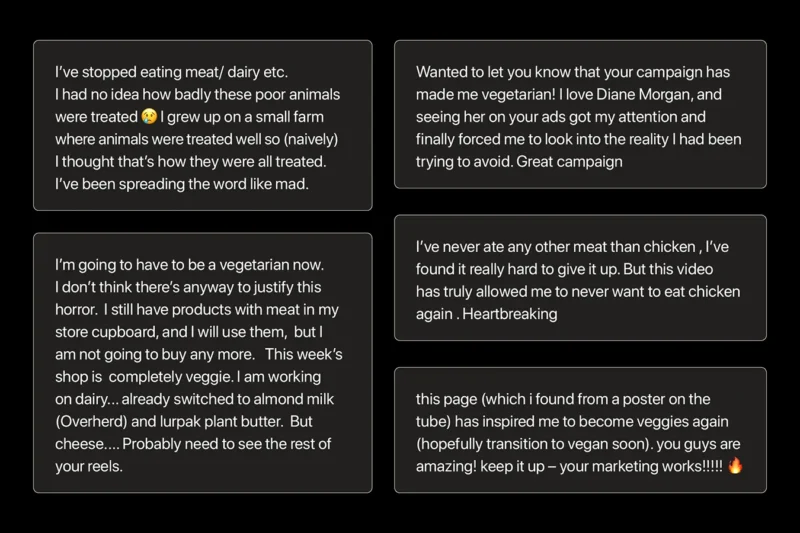
In thousands of comments, people keep saying the same thing in different words: I had no idea. Most weren’t defending the practice. They simply didn’t know it happened. And once they did, many found it indefensible.
Hardly a day goes by without someone from another organisation, a funder or a stranger on LinkedIn telling us they love what we’re doing. The chief executive of one of Britain’s oldest animal charities wrote that the campaign “has really provoked a conversation and changed minds.”
We’re grateful for all of that positive feedback, and we don’t count any of it.
People liking Project Slingshot is not the same as factory farming losing its licence, so we only count evidence about the industry, not compliments about us. For balance, a slice of the vegan community thinks we’re “Project Welfare” for not telling people to go vegan or not focusing on all animal farming, some farmers think we’re attacking them personally, and a trickle of commenters keep asking who funds us. We take the criticism seriously, but none of it has changed our view that the fastest way to help the most animals is to go after the system most people already oppose.
Part three: what didn’t work, and what we’ve learned
We’ve measured a lot, but some of the most important questions are still open. Are we spending our budget in the right places? Are we asking people to take the right actions? Why aren’t we getting more mainstream press, or cutting through the wider online conversation? Why hasn’t grassroots action grown faster? And while MPs are hearing from their constituents, how do we reach the smaller group of people, such as buyers, civil servants and investors, who make the decisions that change how animals are farmed?
We’re publishing these because we have to be honest with ourselves first. An organisation that only reports its wins stops learning, and we can’t afford that if we’re trying to dismantle an industry. We also think the movement needs more of this. Too often campaign reports read like highlight reels, which makes it harder for all of us to learn what works. So here’s what hasn’t gone to plan, and what we’re changing because of it.
Increasing opposition and sustaining action
UK opposition to rearing chickens, pigs and cows in factory farms was around three quarters in September 2025, before we launched, and it was the same in July 2026. People who remember the campaign are no more opposed than people who don’t. That’s what you’d expect after one eight-week campaign, and at 75% there’s limited room for opposition to rise, because we chose an issue the public already agrees on. The bigger task is turning that agreement into action.
What our first 2026 survey shows is that people who saw the campaign now know something they didn’t, and they find it unacceptable: 67% described gas chambers as cruel, and 92% supported mandatory labelling. The challenge now, as a movement, is to turn that sentiment into action, and to sustain it beyond individual campaign drumbeats.
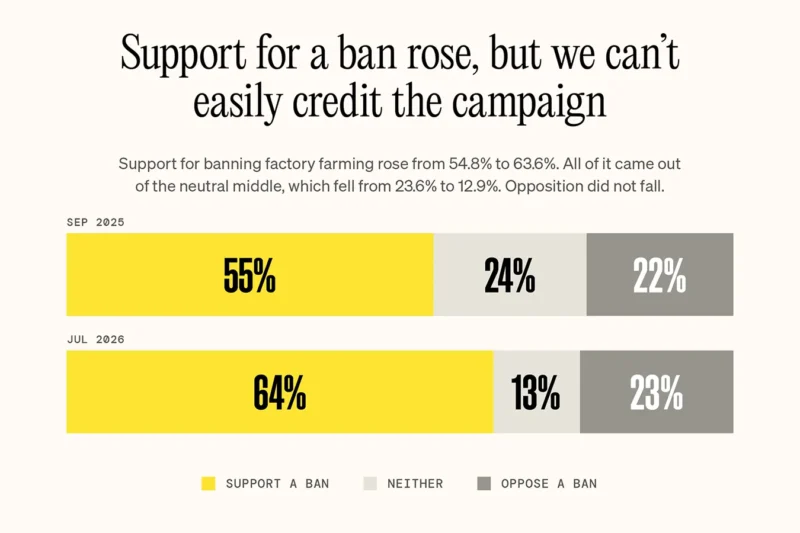
Over the same period, support for banning factory farming also looks to have risen from 55% to 64%. We’d love to take credit but Social Change Lab found no link between that rise and awareness of the campaign, so we can’t. It may reflect the wider conversation, which we’re part of, or it may be noise, and the next research wave will tell us more.
Frankenchickens didn’t resonate like gas chambers
The Frankenchicken drumbeat produced fewer actions, less social conversation and less press than gas chambers, and by late August we had lost much of the early momentum. The political response was particularly stark. Constituents emailed MPs in 523 constituencies about Frankenchickens, but the first supportive responses didn’t arrive until late July, and relatively few have followed. That compares with more than 200 responses on gas chambers.
Our paid petition ads for Frankenchickens also struggled at first to turn interest into signatures at a reasonable cost, so we paused them. In September we relaunched with a new health-focused creative and changed how the ads were optimised, and in its first week it brought in over 1,000 signatures, making it our best week for petitions so far. One week isn’t a trend, but it suggests the problem was partly how we were asking, not just the issue itself. And while the Frankenchicken conversation reached a potential audience of nearly 17 million over 30 days, our social listening showed that much of this came from a handful of large accounts rather than a wider conversation taking hold.
There were real highs: the KFC film did 5.3 million views on Instagram and produced one of our strongest weeks for new followers since launch, and the Pret action showed the audience will move when we give it a clear target. But the pattern is broad and shallow: 95% of people who took an action took only one, and the viral audiences of July were less likely to hand over an email address than the people who found us in April.
We have a few theories as to why. Gas chambers was our launch, London had never seen anything like it, and some of that initial excitement was always going to fade. It may also simply be a stronger story. Almost nobody knows pigs are killed this way, the reality is shocking, there are companies to hold responsible and the solution is easy to understand. “Nine in ten British pigs are killed in gas chambers and virtually nobody knows” is a campaign in one sentence.
Frankenchickens is harder to explain. You have to understand the breeding, the rapid growth and what that does to the birds before you get to who is responsible, and you’re asking people to care about an animal that nearly a quarter of Brits don’t believe is sentient, according to the RSPCA’s 2026 Animal Kindness Index. But we also have to consider that we may simply have told the pig story better. The creative and copy for gas chambers were stronger, which is a lesson in itself: choosing the right issue matters, but so does the quality of the brief and how well we tell the story.
The best drumbeat topics aren’t necessarily the practices causing the most suffering; they’re the ones with the most narrative leverage: unknown, disgusting, easily understood, clearly the industry’s doing, with a villain and an action attached.
Gas chambers scores highly on all of it. Frankenchickens scores lower. Salmon, with its sea lice, dyed flesh and chemical treatments sold as wild and natural, should score highly, which makes it a real test of the idea. We’ll see. The lesson for chicken isn’t that it can’t be done, but that it likely needs stronger creative, a sharper story and a harder disgust angle.
We still don’t know enough about the Underground ads
The July survey confirmed that the Tube ads were reaching people in London; it didn’t tell us which creative landed, which message stuck, and whether celebrity endorsements are paying off. We tested our first ad creative with YouGov, an international market research firm, before launch, but we need more data to ensure our future creative decisions are based on up-to-date evidence. We’re planning further testing accordingly.
The handover to partners needed more careful planning
Our model depends on other organisations converting the attention we generate into bigger wins. We presented Slingshot to some movement leaders in January, months before launch, and we’ve met with plenty of organisations since. But we hadn’t agreed in advance who would follow up on the opportunities the campaign created, or when. Each of those organisations has its own workstreams, targets and timetable, and aligning them around a drumbeat calendar they didn’t set is hard.
That’s a gap we need to fix. From salmon onwards, we want to work more closely with specific partners from the start, planning campaigns together rather than simply telling them what we’re doing. That means looking further ahead and agreeing where public pressure, lobbying, litigation and corporate campaigning can reinforce each other, so everyone has their asks ready before the posters go up rather than scrambling to respond after they come down.
We haven’t cracked mainstream press
The projections onto Parliament and Buckingham Palace, which we expected to be a media moment, drove our biggest week of supporter action but got almost no national coverage. Big Chicken on Netflix, for which we took the cameras to a KFC supplier farm, generated reviews more than news. A campaign that wants to make an industry indefensible needs to be in the national news, not just in social feeds.
We’ve started to address that. We’ve brought investigative journalism into Slingshot, working with some of the country’s most experienced reporters on Big Ag, so that when the posters go up there’s new, reported news to go with them. The first investigation was published this week: Freedom of Information requests showed that bird flu outbreaks have cost UK taxpayers more than £200 million since 2020, including around £94 million paid in compensation to poultry producers, with serious biosecurity failures at several of the farms involved. The British Poultry Council didn’t dispute the figures, and its chief executive said farms that neglected biosecurity shouldn’t be allowed to restock.
The point here isn’t that the movement lacked investigators, but that investigations and public pressure have rarely been timed to land together.
Grassroots coordination was delayed
Before launch we hoped activists would take “Don’t buy it” and run with it: T-shirts on the street, stickers they can use as they wish – our messaging in their hands. We were slow to produce the stickers and the merchandise has yet to launch. Grassroots groups tell us they like what we do, and since April we’ve had a steady stream of “how can I help?” and “can I volunteer?” messages from people the campaign reached, most of which we could only answer with a thank you. We’re a small team with no one whose job is to coordinate a community, so the goodwill piled up while we were busy making the next set of ads. We built the campaign for the public and struggled to build the bits that let the movement amplify it. We hope to fix that this autumn, and we’ll report on whether it worked.
People keep asking what they should do
We said we wouldn’t tell anyone what to eat, and we meant it, because the moment this becomes a diet campaign it becomes an identity fight, and identity fights are how cultivated meat came to be banned in Italy, Hungary and a growing number of US states. But the single most common response from supporters is: fine, so what do I buy? We’ve been developing a practical guide to avoiding factory-farmed food which we’re testing soon, and we suspect it will be one of the most used things we produce.
And the biggest bet is still open
Will sustained exposure break through, or will people look away? This is the bet the whole model rests on, and it’s the one we can’t answer after five months. Two pieces of early evidence point the right way: the knowledge gain reported in the survey increased the more people saw, and we’re reaching people who weren’t already with us – audiences that the movement struggled to engage before. Against that stands the fact that the number of animals farmed in Britain, as everywhere, is still rising, and that around 25,000 pigs were gassed today, as they were yesterday, whatever we put on the walls of Embankment station.
So we’re also looking beyond attitudes. With Bryant Research, we’re analysing Circana supermarket sales data to see whether pork, chicken and salmon sales shifted in London, where our ads were concentrated, compared with the rest of the country, and whether alternatives picked up the difference. We aren’t asking people to change their diets, and we don’t expect a single campaign to cause a major shift here. But sales are one of the places an industry starts to feel it when its practices become harder to defend, so we’re tracking them over time alongside what companies, politicians and the trade press do. First results are due later this autumn, and we’ll share what we find either way.
How Slingshot could be wrong
A few clear signals would tell us we’re wrong. If after sustained campaigning (for us that means 2-3 years), recall is high but it’s not converting to support and action, the approach could be failing. If the practices we target become more acceptable rather than less as they become better known, sustained across survey waves and linked to awareness of the campaign, we’re doing harm and we’ll stop or change course. If partners can’t use the pressure we produce, we’re a campaign rather than an engine, and that would indicate our theory of change didn’t hold up. None of those has happened but all of them are possible.
What comes next
London was the pilot. Next we hope to take the model to the United States, starting in San Francisco and then moving on to New York, Los Angeles and Washington DC, with Europe to follow. The US is the largest factory farming economy on earth, with 99% of its farmed animals in factory farms, and it’s where the industry is fighting back hardest, pushing a bill in Congress that would overturn the crated pork bans voters passed in California and Massachusetts. It will also be a much tougher test than London: a bigger market, more polarised politics and a very different media landscape. If it works there, it can work anywhere, and we can start to turn the tide against factory farming.
We won’t be doing it alone. In the UK, our campaigns are planned around the shared End Factory Farming 2040 roadmap developed with other organisations in the movement, and we’re building the same kind of partnerships in the US, so that the pressure we create lands where the lobbyists, litigators and corporate campaigners can use it. We haven’t proven the model yet, but we think the first five months have shown enough to justify the next stage of the experiment. We’re looking for funders who want to help find out whether a properly funded culture lane can do for factory farming what it did for tobacco.
Why we think this bet is worth making
Slingshot’s theory of change isn’t new. It’s the pattern behind other successful movements against an entrenched, legal, profitable industry, and the best-evaluated example is tobacco. The American “truth” campaign, launched in 2000, did no lobbying and told nobody what to do. It exposed what the industry did and knew, using the deception and disgust frames we use now, backed by roughly $100 million a year in national advertising. Smoking among American students fell from 25.3% in 1999 to 18.0% in 2002, and the independent evaluation attributed around a fifth of that decline, roughly 300,000 fewer teenage smokers, to the campaign, after allowing for the price rises that hit at the same time. The most interesting part for us is the timing: the truth campaign couldn’t show a significant effect on smoking in its first year. The measurable effect appeared in years two and three, and the more advertising young people saw, the stronger it became.
Adult smoking in America fell from 42.4% in 1965 to 11.6% in 2022, not through any single intervention but by making the industry impossible to defend in public, which opened the door to the taxes, the bans and the lawsuits. The industry’s own answers to early pressure were filters and “light” cigarettes, which made the product look safer without making it safer; what did the damage was everything that made smoking socially awkward and expensive.
Tobacco is far from beaten worldwide, with over a billion smokers still, and the industry has moved its growth to other countries, and into vapes. But in Britain, America and other countries, Big Tobacco is a pariah, still profitable but shrinking, fighting a rearguard action rather than persuading anyone it’s normal. The lesson isn’t that public pressure is weak. It’s that it works where it’s sustained and fails where it’s never tried.
That’s the wider point. Against the billions spent every year marketing meat and fast food, the animal movement has invested remarkably little in sustained mass-media counter-messaging, and very few campaigns have run for long enough to find out what sustained investment could achieve.
Mass public campaigning is an intervention whose effects depend on sustained exposure.
That isn’t a claim that public advocacy has been tried and failed; it’s the observation that it has barely been tried at the level needed. The plan to end factory farming needs four lanes moving together: policy, legal, food system and culture. The first three exist and have funding, though never enough. The culture lane, generating the pressure that makes every other lane’s wins easier to land and harder to reverse, has never really been built to its full potential.
That might sound surprising. The movement has spent heavily on public advocacy, and some argue it has been tested and failed: years of diet-change work didn’t measurably change what people eat, so funders moved on. That’s a fair reading of the evidence, but the evidence is about a different question.
Almost all of that spending, and almost all of the research on it, asked individuals to eat differently. The best studies track what people actually eat over days to months, and the effects are small. That’s a real finding about persuading individuals. It tells us much less about what happens when you stop targeting individual plates and start targeting the industry’s ability to defend itself.
That is what we do. We pick one practice at a time, make it impossible to ignore, return to it again and again, and name the companies that rely on it. Our measures follow from that. We track how visible the issue is, how the industry responds, and whether politicians act. These aren’t softer measures than diet change; they track institutional behaviour instead of individual behaviour.
Tobacco shows why this matters. Individual persuasion started the decline in smoking, but it was the industry losing the ability to defend itself that turned a slow decline into a collapse. If the same holds here, this lane makes every other lane cheaper: MPs are already onside when the policy ask arrives, and companies are already exposed when corporate campaigns begin.
Our first campaign is an early test. Public attitudes barely moved in the survey afterwards. But a major pork supplier switched off its social media comments for months, the grocery trade press asked whether meat faces its “tobacco moment,” and MPs raised the issue in Parliament after hearing from constituents. One campaign proves nothing on its own, but these are the patterns we’ll look for.
The money is starting to follow. More than 3,000 people have donated to Slingshot since launch, nearly half of them monthly. Foundations that had never funded animal causes have got in touch after seeing the posters, and the funders backing our expansion to the US later this year have done so on the strength of what London has shown. None of that is evidence that factory farming is losing its licence. It’s evidence that people who look closely at the model think it’s worth the bet.
Norm change isn’t linear. There may be years where the metrics look flat before a tipping point, and the industry will fight back, spending heavily to make those years longer. Corporate commitments made without public pressure behind them get abandoned, as eighteen UK restaurant chains demonstrated in February when they walked away from a chicken welfare pledge months before its deadline. Policy matters, corporate campaigning matters, litigation matters, alternatives matter, and welfare reforms matter to the animals living through this system today.
Our argument is simply that none of those things should have to fight uphill against a culture in which factory farming stays invisible and normal. The question for the money arriving in this movement over the next few years is whether it goes towards making factory farming indefensible, or towards making it easier to live with.
We know which side of that we’re on, and we’ll keep publishing the evidence so you can decide whether we’ve earned your backing.
That was a lot of words, and it’s still not the whole story. If you’re left with any questions, please send them our way. We welcome both feedback and pushback – anything that helps us learn faster – and look forward to hearing from you.
Special thanks to Emma Slawinski – League Against Cruel Sports, Sam Nadel – Social Change Lab, Mark Westcombe – Animal Think Tank and Vishwa Dave – Karuna Foundation, for their comments on earlier drafts. Thanks to Social Change Lab for the public opinion research, and to all of our supporters who’ve donated, taken an action, or shared the campaign.